
Bioactive Molecules from Tenebrio molitor: An Interdisciplinary Perspective on Structural Biology, Antiviral Pharmacology, and One Health
Article Sidebar
Main Article Content
Abstract
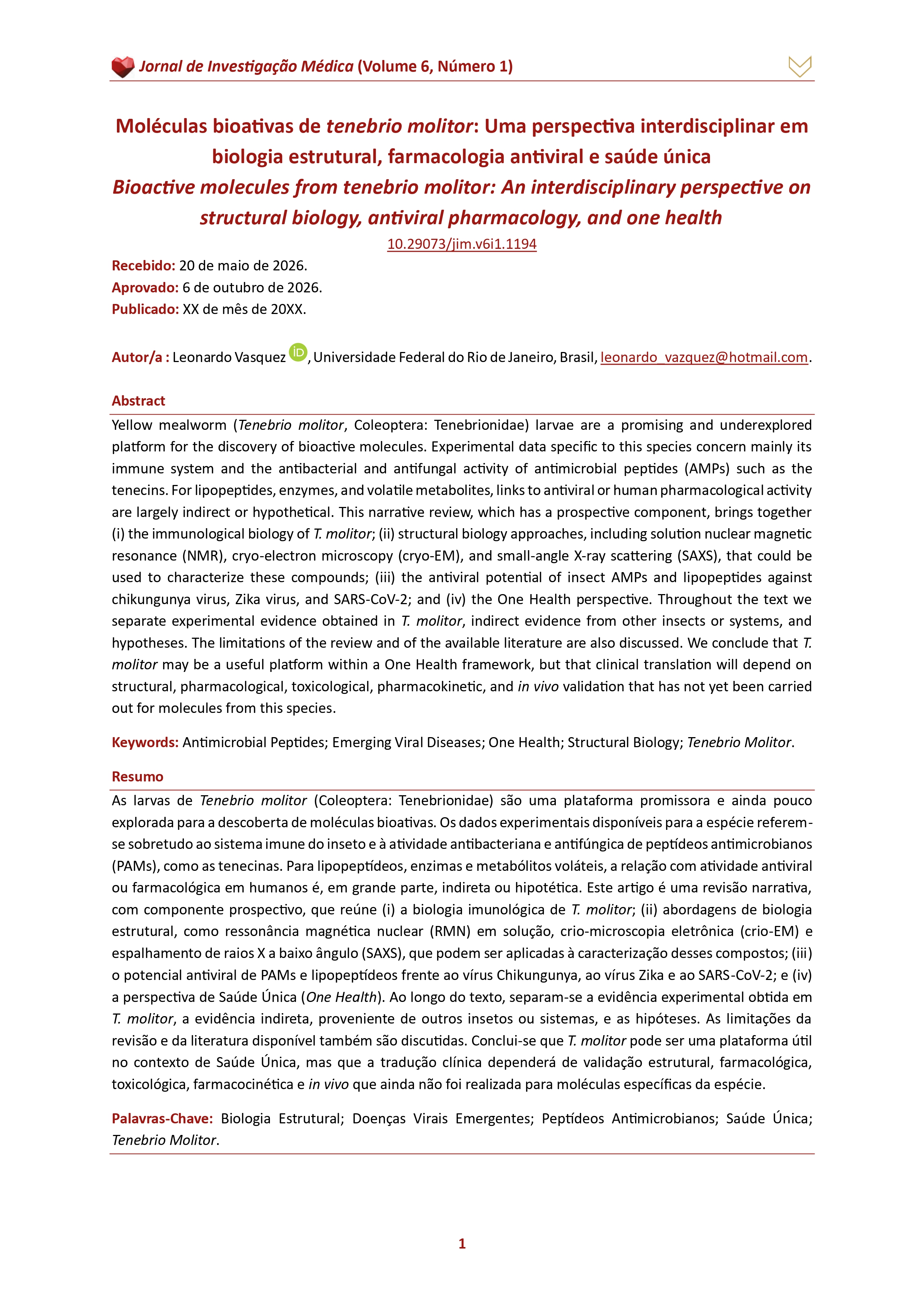
Tenebrio molitor (Coleoptera: Tenebrionidae) larvae represents one of the most promising biological systems in contemporary biotechnology, providing rich sources of antimicrobial peptides (AMPs), lipopeptides, hydrolytic enzymes, and volatile metabolites with relevant pharmacological activity. In the current context of global antimicrobial resistance and the continuous emergence of arboviruses with high pandemic potential — including Chikungunya, Zika, and SARS-CoV-2 — the investigation of insect-derived molecules constitutes a simultaneous pioneering and urgent scientific frontier. This article proposes an interdisciplinary review integrating (i) the immunological biology of T. molitor as a source of bioactive compounds; (ii) structural biology approaches — including solution Nuclear Magnetic Resonance (NMR), cryo-electron microscopy (cryo-EM), and small-angle X-ray scattering (SAXS) — applied to the molecular characterization of these compounds; (iii) the antiviral potential of insect AMPs and lipopeptides against viruses of global health relevance; and (iv) the One Health perspective, which positions insects as critical elements at the interface between ecosystems, agriculture, and human health. The convergence of these dimensions reveals that T. molitor is not merely an organism of dietary interest, but a multifunctional biotechnological platform with profound implications for novel drug discovery and emerging disease surveillance.
Downloads
Article Details

This work is licensed under a Creative Commons Attribution 4.0 International License.
References
Adisasmito, W. B., Almuhairi, S., Behravesh, C. B., et al. (2022). One Health: A new definition for a sustainable and healthy future. PLoS Pathogens, 18(6), e1010537. https://doi.org/10.1371/journal.ppat.1010537
Andersson, D. I., Hughes, D., & Kubicek-Sutherland, J. Z. (2016). Mechanisms and consequences of bacterial resistance to antimicrobial peptides. Drug Resistance Updates, 26, 43–57. https://doi.org/10.1016/j.drup.2016.04.002
Berneck, B. S. M., Wichit, S., Hamel, R., Choumet, V., Liabeuf, S., Diop, F., & Misse, D. (2019). Chikungunya virus: An overview. Médecine/Sciences, 35(5), 441–449. https://doi.org/10.1051/medsci/2019085
Boman, H. G. (1995). Peptide antibiotics and their role in innate immunity. Annual Review of Immunology, 13, 61–92. https://doi.org/10.1146/annurev.iy.13.040195.000425
Bonmatin, J. M., Genest, M., Labbé, H., & Ptak, M. (1994). Solution three-dimensional structure of surfactin: A cyclic lipopeptide studied by 1H-NMR, distance geometry, and molecular dynamics. Biopolymers, 34(7), 975–986. https://doi.org/10.1002/bip.360340716
Brandon, A. M., Gao, S.-H., Tian, R., Ning, D., Yang, S.-S., Zhou, J., Wu, W.-M., & Criddle, C. S. (2018). Biodegradation of polyethylene and plastic mixtures in mealworms (larvae of Tenebrio molitor) and effects on the gut microbiome. Environmental Science & Technology, 52(11), 6526–6533. https://doi.org/10.1021/acs.est.8b02301
Bulet, P., Stöcklin, R., & Menin, L. (2004). Anti-microbial peptides: From invertebrates to vertebrates. Immunological Reviews, 198, 169–184. https://doi.org/10.1111/j.0105-2896.2004.0124.x
Cerovsky, V., & Bem, R. (2014). Lucifensins, the insect defensins of medicinal maggots: The story behind maggot therapy. Pharmaceuticals, 7(3), 251–264. https://doi.org/10.3390/ph7030251
Chae, J.-H., Kurokawa, K., So, Y.-I., Hwang, H. O., Kim, M.-S., Park, J.-W., Jo, Y.-H., Lee, Y. S., & Lee, B. L. (2012). Purification and characterization of tenecin 4, a new anti-Gram-negative bacterial peptide, from the beetle Tenebrio molitor. Developmental & Comparative Immunology, 36(3), 540–546.
Chaves, O. A., Lima, C. R., Fintelman-Rodrigues, N., Sacramento, C. Q., de Freitas, C. S., Vazquez, L., Temerozo, J. R., Rocha, M. E. N., Dias, S. S. G., Carels, N., Bozza, P. T., Castro-Faria-Neto, H. C., & Souza, T. M. L. (2022a). Agathisflavone, a natural biflavonoid that inhibits SARS-CoV-2 replication by targeting its proteases. International Journal of Biological Macromolecules, 222, 1015–1026. https://doi.org/10.1016/j.ijbiomac.2022.09.204
Chaves, O. A., Sacramento, C. Q., Ferreira, A. C., Mattos, M., Fintelman-Rodrigues, N., Temerozo, J. R., Vazquez, L., Pinto, D. P., da Silveira, G. P. E., da Fonseca, L. B., Pereira, H. M., Carlos, A. S., D'Avila, J. C., Viola, J. P. B., Monteiro, R. Q., Bozza, P. T., Castro-Faria-Neto, H. C., & Souza, T. M. L. (2022c). Atazanavir is a competitive inhibitor of SARS-CoV-2 Mpro, impairing variants replication in vitro and in vivo. Pharmaceuticals, 15(1), 21. https://doi.org/10.3390/ph15010021
Chaves, O. A., Sacramento, C. Q., Fintelman-Rodrigues, N., Temerozo, J. R., Pereira-Dutra, F., Mizurini, D. M., Monteiro, R. Q., Vazquez, L., Bozza, P. T., Castro-Faria-Neto, H. C., & Souza, T. M. L. (2022b). Apixaban, an orally available anticoagulant, inhibits SARS-CoV-2 replication and its major protease in a non-competitive way. Journal of Molecular Cell Biology, 14, mjac039. https://doi.org/10.1093/jmcb/mjac039
Di, L. (2015). Strategic approaches to optimizing peptide ADME properties. The AAPS Journal, 17(1), 134–143. https://doi.org/10.1208/s12248-014-9687-3
Dos Santos-Filho, T. J., Vazquez, L., Chaves, O. A., Cordeiro, B. M., Fontes, C. F. L., & Mignaco, J. A. (2026). Synthesis and functional characterization of a recombinant HIV-1 reverse transcriptase variant carrying twelve drug-resistance mutations as a platform for antiretroviral screening. International Journal of Biological Macromolecules, 349, 150723. https://doi.org/10.1016/j.ijbiomac.2026.150723
Edosa, T. T., Jo, Y. H., Keshavarz, M., Kim, I. S., & Han, Y. S. (2020). Biosurfactants induce antimicrobial peptide production through the activation of TmSpatzles in Tenebrio molitor. International Journal of Molecular Sciences, 21(17), 6090. https://doi.org/10.3390/ijms21176090
EFSA Panel on Nutrition, Novel Foods and Food Allergens. (2021). Safety of dried yellow mealworm (Tenebrio molitor larva) as a novel food pursuant to Regulation (EU) 2015/2283. EFSA Journal, 19(1), 6343. https://doi.org/10.2903/j.efsa.2021.6343
Epand, R. M., & Vogel, H. J. (1999). Diversity of antimicrobial peptides and their mechanisms of action. Biochimica et Biophysica Acta, 1462(1–2), 11–28. https://doi.org/10.1016/S0005-2736(99)00198-4
European Centre for Disease Prevention and Control. (2026). Factsheet for health professionals about chikungunya virus disease. https://www.ecdc.europa.eu/en/chikungunya/facts/factsheet
European Commission. (2021). Commission Implementing Regulation (EU) 2021/882 of 1 June 2021 authorising the placing on the market of dried Tenebrio molitor larva as a novel food pursuant to Regulation (EU) 2015/2283 of the European Parliament and of the Council, and amending Commission Implementing Regulation (EU) 2017/2470. Official Journal of the European Union, L 194, 16–20.
Fosgerau, K., & Hoffmann, T. (2015). Peptide therapeutics: Current status and future directions. Drug Discovery Today, 20(1), 122–128. https://doi.org/10.1016/j.drudis.2014.10.003
Godoy, A. S., Lima, G. M. A., Oliveira, K. I. Z., et al. (2017). Crystal structure of Zika virus NS5 RNA-dependent RNA polymerase. Nature Communications, 8, 14764. https://doi.org/10.1038/ncomms14764
Gonzalez-de la Rosa, T., Márquez-Paradas, E., Leon, M. J., Montserrat-de la Paz, S., & Rivero-Pino, F. (2025). Exploring Tenebrio molitor as a source of low-molecular-weight antimicrobial peptides using an in silico approach: Correlation of molecular features and molecular docking. Journal of the Science of Food and Agriculture, 105(3), 1711–1736. https://doi.org/10.1002/jsfa.13949
Hancock, R. E. W., & Sahl, H. G. (2006). Antimicrobial and host-defense peptides as new anti-infective therapeutic strategies. Nature Biotechnology, 24(12), 1551–1557. https://doi.org/10.1038/nbt1267
Houben, D., Daoulas, G., Faucon, M.-P., & Dulaurent, A.-M. (2020). Potential use of mealworm frass as a fertilizer: Impact on crop growth and soil properties. Scientific Reports, 10, 4659. https://doi.org/10.1038/s41598-020-61765-x
Hultmark, D. (2003). Drosophila immunity: Paths and patterns. Current Opinion in Immunology, 15(1), 12–19. https://doi.org/10.1016/S0952-7915(02)00005-5
Jenssen, H., Hamill, P., & Hancock, R. E. W. (2006). Peptide antimicrobial agents. Clinical Microbiology Reviews, 19(3), 491–511. https://doi.org/10.1128/CMR.00056-05
Jin, Z., Du, X., Xu, Y., et al. (2020). Structure of Mpro from SARS-CoV-2 and discovery of its inhibitors. Nature, 582, 289–293. https://doi.org/10.1038/s41586-020-2223-y
Johnston, P. R., Makarova, O., & Rolff, J. (2014). Inducible defenses stay up late: Temporal patterns of immune gene expression in Tenebrio molitor. G3: Genes, Genomes, Genetics, 4(6), 947–955. https://doi.org/10.1534/g3.113.008516
Jumper, J., Evans, R., Pritzel, A., et al. (2021). Highly accurate protein structure prediction with AlphaFold. Nature, 596, 583–589. https://doi.org/10.1038/s41586-021-03819-2
Kracht, M., Rokos, H., Özel, M., Kowall, M., Pauli, G., & Vater, J. (1999). Antiviral and hemolytic activities of surfactin isoforms and their methyl ester derivatives. The Journal of Antibiotics, 52(7), 613–619. https://doi.org/10.7164/antibiotics.52.613
Lazear, H. M., & Diamond, M. S. (2016). Zika virus: New clinical syndromes and its emergence in the Western Hemisphere. Journal of Virology, 90(10), 4864–4875. https://doi.org/10.1128/JVI.00252-16
Lazzaro, B. P., Zasloff, M., & Rolff, J. (2020). Antimicrobial peptides: Application informed by evolution. Science, 368(6490), eaau5480. https://doi.org/10.1126/science.aau5480
Lee, K. H., Hong, Y. S., Oh, J. E., Kwon, M., Yoon, J. H., Lee, J., Lee, B. L., & Moon, H. M. (1998). Identification and characterization of the antimicrobial peptide corresponding to C-terminal β-sheet domain of tenecin 1, an antibacterial protein of larvae of Tenebrio molitor. Biochemical Journal, 334(1), 99–105. https://doi.org/10.1042/bj3340099
Lemaitre, B., & Hoffmann, J. (2007). The host defense of Drosophila melanogaster. Annual Review of Immunology, 25, 697–743. https://doi.org/10.1146/annurev.immunol.25.022106.141615
Magana, M., Pushpanathan, M., Santos, A. L., et al. (2020). The value of antimicrobial peptides in the age of resistance. The Lancet Infectious Diseases, 20(9), e216–e230. https://doi.org/10.1016/S1473-3099(20)30327-3
Murray, C. J. L., Ikuta, K. S., Sharara, F., et al. (2022). Global burden of bacterial antimicrobial resistance in 2019: A systematic analysis. The Lancet, 399(10325), 629–655. https://doi.org/10.1016/S0140-6736(21)02724-0
Otvos, L., Jr. (2000). Insect peptides with improved protease-resistance protect mice and rats against bacterial infection. Protein Science, 9(4), 742–749. https://doi.org/10.1110/ps.9.4.742
Peypoux, F., Bonmatin, J. M., & Wallach, J. (1999). Recent trends in the biochemistry of surfactin. Applied Microbiology and Biotechnology, 51(5), 553–563. https://doi.org/10.1007/s002530051432
Przemieniecki, S. W., Kosewska, A., Ciesielski, S., & Kosewska, O. (2020). Changes in the gut microbiome and enzymatic profile of Tenebrio molitor larvae biodegrading cellulose, polyethylene and polystyrene waste. Environmental Pollution, 256, 113265. https://doi.org/10.1016/j.envpol.2019.113265
Song, H., Zhao, Z., Chai, Y., Jin, X., Li, C., Yuan, F., Liu, S., Gao, Z., Wang, H., Song, J., Vazquez, L., Zhang, Y., Tan, S., Morel, C. M., Yan, J., Shi, Y., Qi, J., Gao, F., & Gao, G. F. (2019). Molecular basis of arthritogenic alphavirus receptor MXRA8 binding to Chikungunya virus envelope protein. Cell, 177(7), 1714–1724.e12. https://doi.org/10.1016/j.cell.2019.04.008
van Huis, A., Van Itterbeeck, J., Klunder, H., Mertens, E., Halloran, A., Muir, G., & Vantomme, P. (2013). Edible insects: Future prospects for food and feed security (FAO Forestry Paper 171). Food and Agriculture Organization of the United Nations.
Vazquez, L., Teixeira da Silva Ferreira, A., Cavalcante, F. S., Garcia, I. J. P., dos Santos, K. R. N., Barbosa, L. A. O., Almeida, M. S., Mignaco, J. A., & Fontes, C. F. L. (2018). Properties of novel surfactin-derived biosurfactants obtained through solid-phase synthesis. Journal of Peptide Science, 24, e3129. https://doi.org/10.1002/psc.3129
Veltri, D., Kamath, U., & Shehu, A. (2018). Deep learning improves antimicrobial peptide recognition. Bioinformatics, 34(16), 2740–2747. https://doi.org/10.1093/bioinformatics/bty179
Vollenbroich, D., Özel, M., Vater, J., Kamp, R. M., & Pauli, G. (1997). Mechanism of inactivation of enveloped viruses by the biosurfactant surfactin from Bacillus subtilis. Biologicals, 25(3), 289–297. https://doi.org/10.1006/biol.1997.0099
World Health Organization. (2015). Global action plan on antimicrobial resistance. WHO. https://www.who.int/publications/i/item/9789241509763
Wrapp, D., Wang, N., Corbett, K. S., et al. (2020). Cryo-EM structure of the 2019-nCoV spike in the prefusion conformation. Science, 367(6483), 1260–1263. https://doi.org/10.1126/science.abb2507
Wüthrich, K. (1986). NMR of proteins and nucleic acids. Wiley-Interscience.
Yan, R., Zhang, Y., Li, Y., et al. (2020). Structural basis for the recognition of SARS-CoV-2 by full-length human ACE2. Science, 367(6485), 1444–1448. https://doi.org/10.1126/science.abb2762
Yang, Y., Yang, J., Wu, W.-M., Zhao, J., Song, Y., Gao, L., Yang, R., & Jiang, L. (2015). Biodegradation and mineralization of polystyrene by plastic-eating mealworms: Part 1. Chemical and physical characterization and isotopic tests. Environmental Science & Technology, 49(20), 12080–12086. https://doi.org/10.1021/acs.est.5b02661
Yi, H. Y., Chowdhury, M., Huang, Y. D., & Yu, X. Q. (2014). Insect antimicrobial peptides and their applications. Applied Microbiology and Biotechnology, 98(13), 5807–5822. https://doi.org/10.1007/s00253-014-5792-6
Yuan, L., Zhang, S., Wang, Y., Li, Y., Wang, X., & Yang, Q. (2018). Surfactin inhibits membrane fusion during invasion of epithelial cells by enveloped viruses. Journal of Virology, 92(21), e00809-18. https://doi.org/10.1128/JVI.00809-18
Zasloff, M. (2002). Antimicrobial peptides of multicellular organisms. Nature, 415(6870), 389–395. https://doi.org/10.1038/415389a