TOURISM, VALUE CREATION AND TERRITORIAL CHANGE: CONTEMPORARY CHALLENGES FOR MANAGEMENT, INNOVATION AND SUSTAINABILITY
Article Sidebar
Main Article Content
Abstract
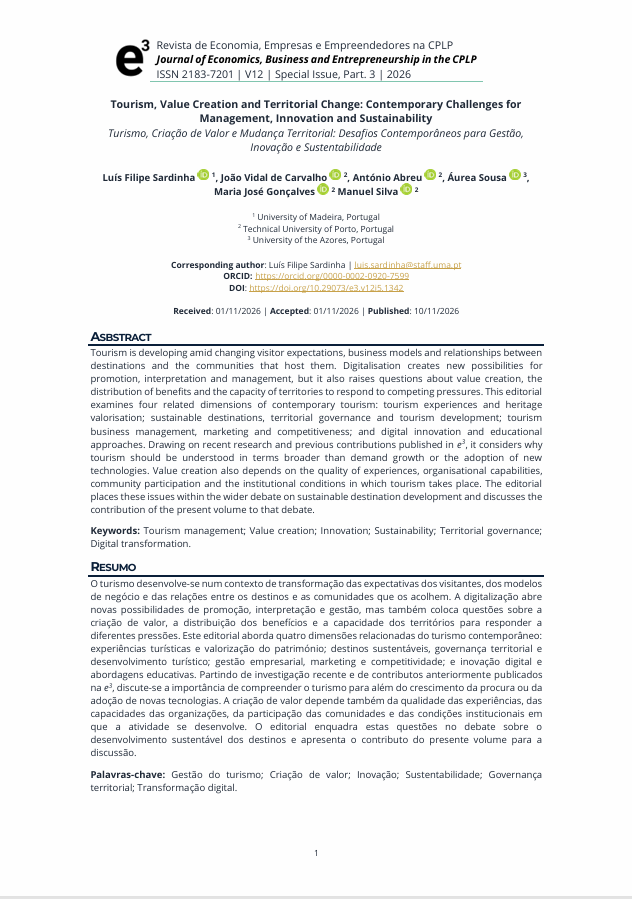
Tourism is developing amid changing visitor expectations, business models and relationships between destinations and the communities that host them. Digitalisation creates new possibilities for promotion, interpretation and management, but it also raises questions about value creation, the distribution of benefits and the capacity of territories to respond to competing pressures. This editorial examines four related dimensions of contemporary tourism: tourism experiences and heritage valorisation; sustainable destinations, territorial governance and tourism development; tourism business management, marketing and competitiveness; and digital innovation and educational approaches. Drawing on recent research and previous contributions published in e3, it considers why tourism should be understood in terms broader than demand growth or the adoption of new technologies. Value creation also depends on the quality of experiences, organisational capabilities, community participation and the institutional conditions in which tourism takes place. The editorial places these issues within the wider debate on sustainable destination development and discusses the contribution of the present volume to that debate.
Downloads
Article Details

This work is licensed under a Creative Commons Attribution 4.0 International License.
All articles published in e3 – Journal of Economics, Business and Entrepreneurship in the community of Portuguese-speaking countries are licensed under the Creative Commons Attribution (CC BY) license.
This license allows users to share (copy and redistribute the material in any medium or format) and adapt (remix, transform, and build upon the material) for any purpose, including commercial use, provided that appropriate credit is given to the original author(s) and the journal, a link to the license is provided, and any changes made are indicated.



References
Abreu, A., Carvalho, J. V., Sardinha, L. F., Sousa, Á., Gonçalves, M. J., & Silva, M. (2026). Tourism, innovation and territorial development: contemporary dynamics and sustainability challenges. In E3 Journal of Economics, Business and Entrepreneurship in the Community of Portuguese-Speaking Countries (Vol. 12, Number 3, pp. 01–05). Ponteditora. https://doi.org/10.29073/e3.v12i3.1103
Ates, H. (2026). Human-centered GenAI feedback design in higher education: a multisite experiment on direct, reflective, and hybrid approaches to scientific argumentation. International Journal of Educational Technology in Higher Education, 23(1), 38. https://doi.org/10.1186/s41239-026-00614-9
Ballina, F. J. (2026). Integration over intensity: field-experimental evidence on phygital design in heritage tourism. Information Technology & Tourism, 28(2), 61. https://doi.org/10.1007/s40558-026-00403-0
Barreth, A., Alvarado, E., & Chalen, D. (2025). CULTURAL TOURISM PRODUCT FOR THE CANTON GENERAL VILLAMIL PLAYAS, ECUADOR. E3, 11(2), 07–20. https://doi.org/10.29073/e3.v12i3.1081
Carvalho, H., Pocinho, R., Casillas-Martín, S., & García-Peñalvo, F. (2026). PREPARATION AND PERCEIVED APTITUDE IN HIGHER EDUCATION IN PORTUGAL. E3, 12(1), 141–155. https://doi.org/10.29073/e3.v9i1.1055
Chang, T.-Y., Tsai, H.-Y., Wu, T.-H., & Su, C.-M. (2026). Developing a decision framework for selecting key opinion leaders in hospitality marketing: A Fuzzy Delphi and AHP approach. International Journal of Hospitality Management, 135, 104608. https://doi.org/10.1016/j.ijhm.2026.104608
Chen, L., Li, X., Zhang, J., Zhang, M., & Liu, S. (2026). Humorous or serious? The impact of heritage interpretation styles on tourists’ memorable tourism experiences. Journal of Hospitality and Tourism Management, 68, 101545. https://doi.org/10.1016/j.jhtm.2026.101545
Coelho, J., & Lima, D. (2025). ACADEMIC INTELLIGENCE: DATA, TECHNOLOGY, AND EDUCATIONAL TOURISM IN SYNERGY. E3, 11(2), 65–74. https://doi.org/10.29073/e3.v11i2.1045
Esteves, E., Ribeiro, M., & Morais, E. (2025). DIGITAL MARKETING IN THE TOURIST RESORTS OF TERRAS DE TRÁS-OS-MONTES. E3, 11(2), 47–56. https://doi.org/10.29073/e3.v12i3.1092
Kar, T., Öztürk, F., Özkaya, M., & Öçal, M. F. (2026). Exploring Teachers’ Practices and Intentions in Formulating Geometry Problems to Support Student Learning. International Journal of Science and Mathematics Education, 24(3), 29. https://doi.org/10.1007/s10763-026-10646-2
Lee, H., Li, P., Chen, P., Huang, Y., & Wu, T. (2026). Enhancing Flipped Learning With Convergent Feedback: The Impact of GPTutor on Knowledge Construction, Motivation and Engagement in Higher Education. European Journal of Education, 61(1). https://doi.org/10.1111/ejed.70527
Liu, Y., Chia, K. W., Katahenggam, N., Sthapit, E., Garrod, B., & Zerman, S. (2026). Dual mediating role of perceived authenticity and place satisfaction on intention to revisit a technology-enhanced cultural heritage tourism site. Journal of Vacation Marketing. https://doi.org/10.1177/13567667261473693
Mandić, A., & Pivčević, S. (2026). Living Labs as Governance Mechanisms for Sustainable Tourism Monitoring: Evidence From Six European Destinations. International Journal of Tourism Research, 28(3). https://doi.org/10.1002/jtr.70346
Napierała, T., & Tomczyk, A. T. (2026). New face of platform capitalism in lodging industry: Who and where adopts platform-led loyalty tools? Tourism Economics, 32(4), 879–903. https://doi.org/10.1177/13548166261421402
Peco-Torres, F., Jones, A., Polo-Peña, A. I., & Frías-Jamilena, D. M. (2026). Customer brand engagement via value co-creation with hotel online media and travel websites and its effect on brand equity: the moderating role of culture. Journal of Hospitality and Tourism Technology, 17(1), 192–211. https://doi.org/10.1108/JHTT-06-2024-0362
Pedrosa, A., Martins, F., Breda, Z., Lois González, R., & Costa, A. P. (2026). Critical success factors for tourism routes: insights from route characteristics. Journal of Tourism and Cultural Change, 24(2), 282–303. https://doi.org/10.1080/14766825.2026.2669169
Rodríguez, M., Mora-Jácome, V., & Vallejo, L. (2025). IMPACT OF SOCIODEMOGRAPHIC VARIABLES ON THE CHOICE OF URBAN TOURIST ATTRACTIONS APPLYING PLOG’S THEORY. E3, 11(2), 137–146. https://doi.org/10.29073/e3.v12i3.1067
Rosalina, P. D., & Teoh, M. W. (2026). Crafting wellness tourism products for sustainable development: Local stakeholders’ perspectives. Journal of Hospitality and Tourism Management, 67, 101426. https://doi.org/10.1016/j.jhtm.2026.101426
Seixas Sardinha, L. F., Fernandes, D. N., & Moura, J. (2019). Alojamento Local na Região Autónoma da Madeira - Tipologia e distribuição do Imóvel. O Perfil do Investidor. Revista de Economia Empresas e Empreendedores Na CPLP, 4(No2), 25–56. https://doi.org/10.29073/e3.v4i2.129
Sofi, M. R., Bashir, I., Alshiha, A. A., Alnasser, E. M., Alkhozaim, S. M., Charag, A. H., & Alshiha, F. A. (2026). From Digital Strategies to Loyal Stays: Exploring the Impact of DMC , CRM , and Trust on Hotel Revisit Intentions. International Journal of Tourism Research, 28(2). https://doi.org/10.1002/jtr.70235
Suasnavas Rodríguez, M. (2026). TOURISM DEVELOPMENT AND PLANNING ZAMORA- ECUADOR. E3, 12(4), 29–41. https://doi.org/10.29073/e3.v12i4.1144
Valencia-Arias, A., Cardona-Acevedo, S., Palacios Moya, L., Londoño-Celis, W., Hernandez, J., & Vanegas, E. (2026). PLANNING IN TOURISM DEVELOPMENT: A SYSTEMATIC REVIEW OF THE LITERATURE ON APPROACHES, MODELS AND APPLICATIONS. E3, 12(4), 11–27. https://doi.org/10.29073/e3.v12i4.1148
Vidal Carvalho, J., Abreu, A., Sardinha, L. F., Sousa, Á., Gonçalves, M. J., & Silva, M. (2026). RECONFIGURING TOURISM SYSTEMS: DIGITAL INTELLIGENCE, TERRITORIAL GOVERNANCE AND ORGANIZATIONAL TRANSFORMATION. E3, 12(4), 01–09. https://doi.org/10.29073/e3.v12i4.1202
Wang, K., Qin, S., Shen, Y., Guo, J., Ruan, Q., & Jia, T. (2026). Effects of AI chatbot‐supported cooperative flipped classroom on student collaboration, self‐regulated learning and academic performance: A mastery learning perspective. British Journal of Educational Technology. https://doi.org/10.1111/bjet.70079
Zhang, L., & McCartney, G. (2026). The Mediating Role of Positive Empathy in Resident Participation in Sustainable Tourism: Evidence From an Ancient Chinese Town. International Journal of Tourism Research, 28(2). https://doi.org/10.1002/jtr.70301