
THE DEVELOPMENT OF REVENUE MANAGEMENT IN THE HOTEL AND RESTAURANT BUSINESSES
Article Sidebar
Main Article Content
Abstract
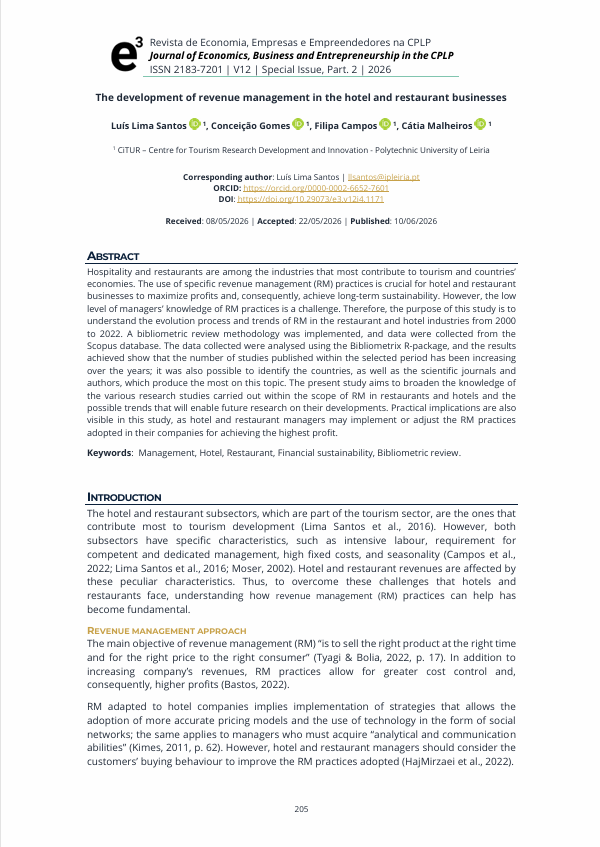
Hospitality and restaurants are among the industries that most contribute to tourism and countries’ economies. The use of specific revenue management (RM) practices is crucial for hotel and restaurant businesses to maximize profits and, consequently, achieve long-term sustainability. However, the low level of managers’ knowledge of RM practices is a challenge. Therefore, the purpose of this study is to understand the evolution process and trends of RM in the restaurant and hotel industries from 2000 to 2022. A bibliometric review methodology was implemented, and data were collected from the Scopus database. The data collected were analyzed using the Bibliometrix R-package, and the results achieved show that the number of studies published within the selected period has been increasing over the years; it was also possible to identify the countries, as well as the scientific journals and authors, which produce the most on this topic. The present study aims to broaden the knowledge of the various research studies carried out within the scope of RM in restaurants and hotels and the possible trends that will enable future research on their developments. Practical implications are also visible in this study, as hotel and restaurant managers may implement or adjust the RM practices adopted in their companies for achieving the highest profit.
Downloads
Article Details

This work is licensed under a Creative Commons Attribution 4.0 International License.
All articles published in e3 – Journal of Economics, Business and Entrepreneurship in the community of Portuguese-speaking countries are licensed under the Creative Commons Attribution (CC BY) license.
This license allows users to share (copy and redistribute the material in any medium or format) and adapt (remix, transform, and build upon the material) for any purpose, including commercial use, provided that appropriate credit is given to the original author(s) and the journal, a link to the license is provided, and any changes made are indicated.



Funding data
-
Fundação para a Ciência e a Tecnologia
Grant numbers UIDB/04470/2020
References
Abrate, G., Sainaghi, R., & Mauri, A. G. (2022). Dynamic pricing in Airbnb: Individual versus professional hosts. Journal of Business Research, 141, 191–199. https://doi.org/10.1016/J.JBUSRES.2021.12.012
Abrate, G., & Viglia, G. (2016). Strategic and tactical price decisions in hotel revenue management. Tourism Management, 55, 123–132. https://doi.org/10.1016/j.tourman.2016.02.006
Araújo, C. (2006). Bibliometria: Evolução histórica e questões atuais. Em Questão, 12(1), 11–32.
Aria, M., & Cuccurullo, C. (2017). Bibliometrix: An R-tool for comprehensive science mapping analysis. Journal of Informetrics, 11(4), 959–975. https://doi.org/10.1016/j.joi.2017.08.007
Bastos, B. P. (2022). Contribution of hotels’ revenue management for supply chain sustainability. Journal of Revenue and Pricing Management. Advance online publication. https://doi.org/10.1057/S41272-022-00380-Z
Buhalis, D., & Leung, R. (2018). Smart hospitality—Interconnectivity and interoperability towards an ecosystem. International Journal of Hospitality Management, 71, 41–50. https://doi.org/10.1016/j.ijhm.2017.11.011
Campos, F., Lima Santos, L., Gomes, C., & Cardoso, L. (2022). Management accounting practices in the hospitality industry: A systematic review and critical approach. Tourism and Hospitality, 3(1), 243–264. https://doi.org/10.3390/tourhosp3010017
Cardoso, L., Chen, M., Araújo, A., Almeida, G., Dias, F., & Moutinho, L. (2022). Accessing neuromarketing scientific performance: Research gaps and emerging topics. Behavioral Sciences, 12(2), 1–20. https://doi.org/10.3390/bs12020055
Cardoso, L., Silva, R., Almeida, G., & Lima Santos, L. (2020). A bibliometric model to analyze country research performance: SciVal topic prominence approach in tourism, leisure and hospitality. Sustainability, 12(23), 1–27. https://doi.org/10.3390/su12239897
Corte, V., Gaudio, G., Sepe, F., & Sciarelli, F. (2019). Sustainable tourism in the open innovation realm: A bibliometric analysis. Sustainability, 11, 6114. https://doi.org/10.3390/su11216114
Cross, R. G., Higbie, J. A., & Cross, D. Q. (2009). Revenue management’s renaissance: A rebirth of the art and science of profitable revenue generation. Cornell Hospitality Quarterly, 50(1), 56–81. https://doi.org/10.1177/1938965508328716
Elmaghraby, W., & Keskinocak, P. (2003). Dynamic pricing in the presence of inventory considerations: Research overview, current practices, and future directions. Management Science, 49(10), 1287–1309. https://doi.org/10.1287/MNSC.49.10.1287.17315
HajMirzaei, M., Ziarati, K., & Nikseresht, A. (2022). A customer type discovery algorithm in hotel revenue management systems. Journal of Revenue and Pricing Management, 21(2), 200–211. https://doi.org/10.1057/S41272-020-00273-Z
Hu, B. A., & Cai, L. A. (2014). Hotel labor productivity assessment: A data envelopment analysis. In Management science applications in tourism and hospitality (pp. 27–38). Routledge. https://doi.org/10.4324/9781315782478
Jerath, K., Netessine, S., & Veeraraghavan, S. K. (2010). Revenue management with strategic customers: Last-minute selling and opaque selling. Management Science, 56(3), 430–448. https://doi.org/10.1287/mnsc.1090.1125
Karaesmen, I., & Van Ryzin, G. (2004). Overbooking with substitutable inventory classes. Operations Research, 52(1), 83–104. https://doi.org/10.1287/opre.1030.0079
Kimes, S. E. (2011). The future of hotel revenue management. Journal of Revenue and Pricing Management, 10(1), 62–72. https://doi.org/10.1057/rpm.2010.47
Kimes, S. E., & Wirtz, J. (2003). Has revenue management become acceptable? Findings from an international study on the perceived fairness of rate fences. Journal of Service Research, 6(2), 125–135. https://doi.org/10.1177/1094670503257038
Lima Santos, L., Gomes, C., Faria, A., Lunkes, R., Malheiros, C., Silva da Rosa, F., & Nunes, C. (2016). Contabilidade de gestão hoteleira (1st ed.). ATF Edições Técnicas.
Lima Santos, L., Silva, R., Cardoso, L., & Oliveira, C. (2022). Accounting and business management research: Tracking 50 years of country performance. Academy of Accounting and Financial Studies Journal, 26(2), 1–22.
Moser, F. (2002). Food and beverage management handbook (1st ed.). CETOP.
Noone, B. M., & Maier, T. A. (2015). A decision framework for restaurant revenue management. Journal of Revenue and Pricing Management, 14(4), 231–244. https://doi.org/10.1057/RPM.2015.15
Noone, B. M., & Mattila, A. S. (2009). Hotel revenue management and the Internet: The effect of price presentation strategies on customers’ willingness to book. International Journal of Hospitality Management, 28(2), 272–279. https://doi.org/10.1016/j.ijhm.2008.09.004
Noone, B. M., McGuire, K. A., & Rohlfs, K. V. (2011). Social media meets hotel revenue management: Opportunities, issues and unanswered questions. Journal of Revenue and Pricing Management, 10(4), 293–305. https://doi.org/10.1057/rpm.2011.12
Phumchusri, N., & Suwatanapongched, P. (2021). Forecasting hotel daily room demand with transformed data using time series methods. Journal of Revenue and Pricing Management. Advance online publication. https://doi.org/10.1057/S41272-021-00363-6
Tyagi, M., & Bolia, N. B. (2022). Approaches for restaurant revenue management. Journal of Revenue and Pricing Management, 21(1), 17–35. https://doi.org/10.1057/S41272-021-00288-0
Vieveen, I. (2017). Lost opportunities in restaurant revenue management. Journal of Revenue and Pricing Management, 17(3), 194–199. https://doi.org/10.1057/s41272-017-0109-x
Vives, A., & Jacob, M. (2021). Dynamic pricing in different Spanish resort hotels. Tourism Economics, 27(2), 398–411. https://doi.org/10.1177/1354816619870652
Weatherford, L. R., & Kimes, S. E. (2003). A comparison of forecasting methods for hotel revenue management. International Journal of Forecasting, 19(3), 401–415. https://doi.org/10.1016/S0169-2070(02)00011-0
Wu, D. C., Zhong, S., Qiu, R. T. R., & Wu, J. (2021). Are customer reviews just reviews? Hotel forecasting using sentiment analysis. Tourism Economics, 28(3), 795–816. https://doi.org/10.1177/13548166211049865