THE ROLE OF RELATIONSHIP MARKETING AND VALUE CO-CREATION IN CUSTOMER LOYALTY: BIBLIOMETRIC REVIEW IN THE HOTEL SECTOR
Article Sidebar
Main Article Content
Abstract
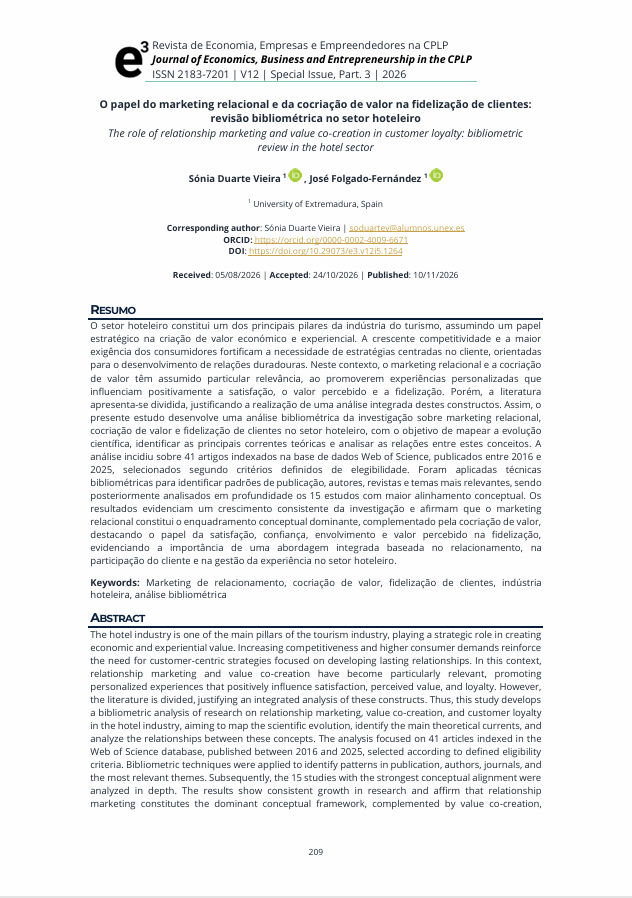
The hotel industry is one of the main pillars of the tourism industry, playing a strategic role in creating economic and experiential value. Increasing competitiveness and higher consumer demands reinforce the need for customer-centric strategies focused on developing lasting relationships. In this context, relationship marketing and value co-creation have become particularly relevant, promoting personalized experiences that positively influence satisfaction, perceived value, and loyalty. However, the literature is divided, justifying an integrated analysis of these constructs. Thus, this study develops a bibliometric analysis of research on relationship marketing, value co-creation, and customer loyalty in the hotel industry, aiming to map the scientific evolution, identify the main theoretical currents, and analyze the relationships between these concepts. The analysis focused on 41 articles indexed in the Web of Science database, published between 2016 and 2025, selected according to defined eligibility criteria. Bibliometric techniques were applied to identify patterns in publication, authors, journals, and the most relevant themes. Subsequently, the 15 studies with the strongest conceptual alignment were analyzed in depth. The results show consistent growth in research and affirm that relationship marketing constitutes the dominant conceptual framework, complemented by value co-creation, highlighting the role of satisfaction, trust, engagement, and perceived value in loyalty, demonstrating the importance of an integrated approach based on relationships, customer participation, and experience management in the hotel industry.
Downloads
Article Details

This work is licensed under a Creative Commons Attribution 4.0 International License.
All articles published in e3 – Journal of Economics, Business and Entrepreneurship in the community of Portuguese-speaking countries are licensed under the Creative Commons Attribution (CC BY) license.
This license allows users to share (copy and redistribute the material in any medium or format) and adapt (remix, transform, and build upon the material) for any purpose, including commercial use, provided that appropriate credit is given to the original author(s) and the journal, a link to the license is provided, and any changes made are indicated.



References
Assiouras, I., Skourtis, G., Giannopoulos, A., Buhalis, D., & Karaosmanoglu, E. (2023). Value co-creation and enjoyment in hospitality services: The mediating role of value-in-use. International Journal of Hospitality Management, 109, Article 103423. https://doi.org/10.1016/j.ijhm.2022.103423
Callon, M., Courtial, J.-P., & Laville, F. (1991). Co-word analysis as a tool for describing the network of interactions between basic and technological research: The case of polymer chemistry. Scientometrics, 22(1), 155–205. https://doi.org/10.1007/BF02019280
Campos, A. C., Mendes, J., do Valle, P. O., & Scott, N. (2018). Co-creation of tourist experiences: A literature review. Current Issues in Tourism, 21(4), 369–400. https://doi.org/10.1080/13683500.2015.1081158
Chen, H., Tsang, Y. P., & Wu, C. H. (2023). When text mining meets science mapping in the bibliometric analysis: A review and future opportunities. International Journal of Engineering Business Management, 15. https://doi.org/10.1177/18479790231222349
Cheraghalizadeh, R., & Dědková, J. (2022). Do service quality and social media marketing improve customer retention in hotels? Testing the mediation effect. E+M Ekonomie a Management, 25(2), 134–151. https://doi.org/10.15240/tul/001/2022-2-008
Cobo, M. J., López-Herrera, A. G., Herrera-Viedma, E., & Herrera, F. (2011). An approach for detecting, quantifying, and visualizing the evolution of a research field. Journal of Informetrics, 5(1), 146–166. https://doi.org/10.1016/j.joi.2010.10.002
Donthu, N., Kumar, S., Mukherjee, D., Pandey, N., & Lim, W. M. (2021). How to conduct a bibliometric analysis: An overview and guidelines. Journal of Business Research, 133, 285–296. https://doi.org/10.1016/j.jbusres.2021.04.070
El-Adly, M. I. (2019). Modelling the relationship between hotel perceived value, customer satisfaction, and customer loyalty. Journal of Retailing and Consumer Services, 50, 322–332. https://doi.org/10.1016/j.jretconser.2018.07.007
González-Mansilla, Ó., Berenguer-Contrí, G., & Serra-Cantallops, A. (2019). The impact of value co-creation on hotel brand equity and customer satisfaction. Tourism Management, 75, 51–65. https://doi.org/10.1016/j.tourman.2019.04.024
Grönroos, C. (2017). Relationship marketing readiness: Theoretical background and measurement directions. Journal of Services Marketing, 31(3), 218–225. https://doi.org/10.1108/JSM-02-2017-0056
Guan, J., Wang, W., Guo, Z., Chan, J. H., & Qi, X. (2021). Customer experience and brand loyalty in the full-service hotel sector: The role of brand affect. International Journal of Contemporary Hospitality Management, 33(5), 1620–1645. https://doi.org/10.1108/IJCHM-10-2020-1177
Inversini, A., De Carlo, M., & Masiero, L. (2020). The effects of customer-centricity in hospitality. International Journal of Hospitality Management, 86, Article 102436. https://doi.org/10.1016/j.ijhm.2019.102436
Kandampully, J., Zhang, T., & Bilgihan, A. (2015). Customer loyalty: A review and future directions with a special focus on the hospitality industry. International Journal of Contemporary Hospitality Management, 27(3), 379–414. https://doi.org/10.1108/IJCHM-03-2014-0151
Kim, C. S., Bai, B. H., Kim, P. B., & Chon, K. (2018). Review of reviews: A systematic analysis of review papers in the hospitality and tourism literature. International Journal of Hospitality Management, 70, 49–58. https://doi.org/10.1016/j.ijhm.2017.10.023
Leminen, S., Nyström, A.-G., & Westerlund, M. (2020). Change processes in open innovation networks. Technological Forecasting and Social Change, 150, Article 119799. https://doi.org/10.1016/j.techfore.2019.119799
Lo, A. S., Im, H. H., Chen, Y., & Qu, H. (2017). Building brand relationship quality among hotel loyalty program members. International Journal of Contemporary Hospitality Management, 29(1), 458–488. https://doi.org/10.1108/IJCHM-06-2015-0283
Magatef, S., Al-Okaily, M., Ashour, L., & Abuhussein, T. (2023). The impact of electronic customer relationship management strategies on customer loyalty. Journal of Open Innovation: Technology, Market, and Complexity, 9(4), Article 100149. https://doi.org/10.1016/j.joitme.2023.100149
Mulet-Forteza, C., Genovart-Balaguer, J., Mauleon-Mendez, E., & Merigó, J. M. (2019). A bibliometric research in the tourism, leisure and hospitality fields. Journal of Business Research, 101, 819–827. https://doi.org/10.1016/j.jbusres.2018.12.002
Perišić Prodan, M., Cerović, M., & Ivančić, I. (2022). The impact of relationship marketing on customer satisfaction and loyalty in luxury hotels. Ekonomska misao i praksa, 31(1), 189–210. https://doi.org/10.17818/EMIP/2022/1.9
Prahalad, C. K., & Ramaswamy, V. (2004). Co-creating unique value with customers. Strategy & Leadership, 32(3), 4–9. https://doi.org/10.1108/10878570410699249
Prebensen, N. K., & Foss, L. (2011). Coping and co-creating in tourist experiences. International Journal of Tourism Research, 13(1), 54–67. https://doi.org/10.1002/jtr.799
Rahimi, R., & Kozak, M. (2017). Impact of customer relationship management on customer satisfaction: The case of a budget hotel chain. Journal of Travel & Tourism Marketing, 34(1), 40–51. https://doi.org/10.1080/10548408.2015.1130108
Rather, R. A. (2018). Investigating the impact of customer brand identification on hospitality brand loyalty: A social identity perspective. Journal of Hospitality Marketing & Management, 27(5), 487–513. https://doi.org/10.1080/19368623.2018.1404539
Rather, R. A. (2021). Customer experience and engagement in tourism destinations: The experiential marketing perspective. Journal of Travel & Tourism Marketing, 38(2), 173–185. https://doi.org/10.1080/10548408.2019.1686101
Rather, R. A., & Hollebeek, L. D. (2021). Customers’ service-related engagement, experience, and behavioral intent: Moderating role of age. Journal of Retailing and Consumer Services, 60, Article 102453. https://doi.org/10.1016/j.jretconser.2021.102453
Rather, R. A., Tehseen, S., Itoo, M. H., & Parrey, S. H. (2019). Customer brand identification, affective commitment, customer satisfaction, and brand trust as antecedents of customer behavioral intention of loyalty. Journal of Hospitality and Tourism Management, 40, 27–37. https://doi.org/10.1016/j.jhtm.2019.05.002
Ribeiro, M. A., Costa, C., Ferreira, A., & Freire, O. (2023). Value co-creation in tourism and hospitality: A systematic review. Tourism Management Perspectives, 45, Article 101045. https://doi.org/10.1016/j.tmp.2022.101045
Santos-Vijande, M. L., López-Sánchez, J. A., & Pascual-Fernández, P. (2018). Co-creation with clients of hotel services: The moderating role of top management support. Current Issues in Tourism, 21(3), 301–327. https://doi.org/10.1080/13683500.2015.1078781
Sigala, M. (2018). Implementing social customer relationship management: A process framework and implications in tourism and hospitality. International Journal of Contemporary Hospitality Management, 30(7), 2698–2726. https://doi.org/10.1108/IJCHM-10-2015-0536
Sigala, M. (2020). Tourism and COVID-19: Impacts and implications. Journal of Business Research, 117, 312–321. https://doi.org/10.1016/j.jbusres.2020.06.003
So, K. K. F., King, C., Sparks, B. A., & Wang, Y. (2016). The role of customer engagement in building consumer loyalty to tourism brands. Journal of Travel Research, 55(1), 64–78. https://doi.org/10.1177/0047287514541008
Van Eck, N. J., & Waltman, L. (2010). Software survey: VOSviewer, a computer program for bibliometric mapping. Scientometrics, 84(2), 523–538. https://doi.org/10.1007/s11192-009-0146-3
Vargo, S. L., & Lusch, R. F. (2004). Evolving to a new dominant logic for marketing. Journal of Marketing, 68(1), 1–17. https://doi.org/10.1509/jmkg.68.1.1.24036
Walls, A. R., Okumus, F., Wang, Y., & Kwun, D. J. (2011). Understanding the consumer experience: An exploratory study of luxury hotels. Journal of Hospitality Marketing & Management, 20(2), 166–197. https://doi.org/10.1080/19368623.2011.536074
Wilkins, H., Merrilees, B., & Herington, C. (2010). The determinants of loyalty in hotels. Journal of Hospitality Marketing & Management, 19(1), 1–21. https://doi.org/10.1080/19368620903327626
Yen, C.-H. (2023). Customer value cocreation behaviors in hospitality: Antecedents and mediators. International Journal of Hospitality Management, 110, Article 103456. https://doi.org/10.1016/j.ijhm.2023.103456
Yu, C., Liang, L. J., & Choi, H. C. (2024). Examining customer value cocreation behavior in boutique hotels: Hospitableness, perceived value, satisfaction, and citizenship behavior. Tourism Analysis, 29(2), 221–237. https://doi.org/10.3727/108354224X17091476372167
Zupic, I., & Čater, T. (2015). Bibliometric methods in management and organization. Organizational Research Methods, 18(3), 429–472. https://doi.org/10.1177/1094428114562629