
- O PAPEL DO MARKETING RELACIONAL E DA COCRIAÇÃO DE VALOR NA FIDELIZAÇÃO DE CLIENTES: REVISÃO BIBLIOMÉTRICA NO SETOR HOTELEIRO
Article Sidebar
Main Article Content
Resumo
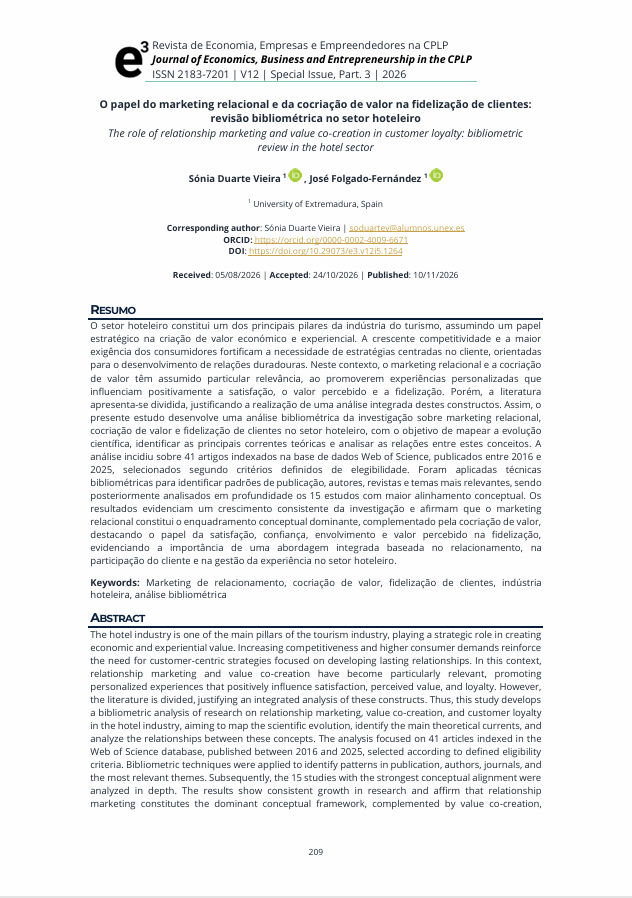
O setor hoteleiro constitui um dos principais pilares da indústria do turismo, assumindo um papel estratégico na criação de valor económico e experiencial. A crescente competitividade e a maior exigência dos consumidores fortificam a necessidade de estratégias centradas no cliente, orientadas para o desenvolvimento de relações duradouras. Neste contexto, o marketing relacional e a cocriação de valor têm assumido particular relevância, ao promoverem experiências personalizadas que influenciam positivamente a satisfação, o valor percebido e a fidelização. Porém, a literatura apresenta-se dividida, justificando a realização de uma análise integrada destes constructos. Assim, o presente estudo desenvolve uma análise bibliométrica da investigação sobre marketing relacional, cocriação de valor e fidelização de clientes no setor hoteleiro, com o objetivo de mapear a evolução científica, identificar as principais correntes teóricas e analisar as relações entre estes conceitos. A análise incidiu sobre 41 artigos indexados na base de dados Web of Science, publicados entre 2016 e 2025, selecionados segundo critérios definidos de elegibilidade. Foram aplicadas técnicas bibliométricas para identificar padrões de publicação, autores, revistas e temas mais relevantes, sendo posteriormente analisados em profundidade os 15 estudos com maior alinhamento conceptual. Os resultados evidenciam um crescimento consistente da investigação e afirmam que o marketing relacional constitui o enquadramento conceptual dominante, complementado pela cocriação de valor, destacando o papel da satisfação, confiança, envolvimento e valor percebido na fidelização, evidenciando a importância de uma abordagem integrada baseada no relacionamento, na participação do cliente e na gestão da experiência no setor hoteleiro.
Downloads
Article Details

Este trabalho encontra-se publicado com a Licença Internacional Creative Commons Atribuição 4.0.
Todos os artigos publicados na e3 – Revista de Economia, Empresas e Empreendedorismo na CPLP são disponibilizados sob a licença Creative Commons Atribuição (CC BY).
Esta licença permite partilhar (copiar e redistribuir o material em qualquer suporte ou formato) e adaptar (remisturar, transformar e criar a partir do material) para qualquer finalidade, incluindo fins comerciais, desde que seja atribuída a devida autoria aos autores e à revista, seja fornecida ligação para a licença e sejam indicadas eventuais alterações.



Referências
Assiouras, I., Skourtis, G., Giannopoulos, A., Buhalis, D., & Karaosmanoglu, E. (2023). Value co-creation and enjoyment in hospitality services: The mediating role of value-in-use. International Journal of Hospitality Management, 109, Article 103423. https://doi.org/10.1016/j.ijhm.2022.103423
Callon, M., Courtial, J.-P., & Laville, F. (1991). Co-word analysis as a tool for describing the network of interactions between basic and technological research: The case of polymer chemistry. Scientometrics, 22(1), 155–205. https://doi.org/10.1007/BF02019280
Campos, A. C., Mendes, J., do Valle, P. O., & Scott, N. (2018). Co-creation of tourist experiences: A literature review. Current Issues in Tourism, 21(4), 369–400. https://doi.org/10.1080/13683500.2015.1081158
Chen, H., Tsang, Y. P., & Wu, C. H. (2023). When text mining meets science mapping in the bibliometric analysis: A review and future opportunities. International Journal of Engineering Business Management, 15. https://doi.org/10.1177/18479790231222349
Cheraghalizadeh, R., & Dědková, J. (2022). Do service quality and social media marketing improve customer retention in hotels? Testing the mediation effect. E+M Ekonomie a Management, 25(2), 134–151. https://doi.org/10.15240/tul/001/2022-2-008
Cobo, M. J., López-Herrera, A. G., Herrera-Viedma, E., & Herrera, F. (2011). An approach for detecting, quantifying, and visualizing the evolution of a research field. Journal of Informetrics, 5(1), 146–166. https://doi.org/10.1016/j.joi.2010.10.002
Donthu, N., Kumar, S., Mukherjee, D., Pandey, N., & Lim, W. M. (2021). How to conduct a bibliometric analysis: An overview and guidelines. Journal of Business Research, 133, 285–296. https://doi.org/10.1016/j.jbusres.2021.04.070
El-Adly, M. I. (2019). Modelling the relationship between hotel perceived value, customer satisfaction, and customer loyalty. Journal of Retailing and Consumer Services, 50, 322–332. https://doi.org/10.1016/j.jretconser.2018.07.007
González-Mansilla, Ó., Berenguer-Contrí, G., & Serra-Cantallops, A. (2019). The impact of value co-creation on hotel brand equity and customer satisfaction. Tourism Management, 75, 51–65. https://doi.org/10.1016/j.tourman.2019.04.024
Grönroos, C. (2017). Relationship marketing readiness: Theoretical background and measurement directions. Journal of Services Marketing, 31(3), 218–225. https://doi.org/10.1108/JSM-02-2017-0056
Guan, J., Wang, W., Guo, Z., Chan, J. H., & Qi, X. (2021). Customer experience and brand loyalty in the full-service hotel sector: The role of brand affect. International Journal of Contemporary Hospitality Management, 33(5), 1620–1645. https://doi.org/10.1108/IJCHM-10-2020-1177
Inversini, A., De Carlo, M., & Masiero, L. (2020). The effects of customer-centricity in hospitality. International Journal of Hospitality Management, 86, Article 102436. https://doi.org/10.1016/j.ijhm.2019.102436
Kandampully, J., Zhang, T., & Bilgihan, A. (2015). Customer loyalty: A review and future directions with a special focus on the hospitality industry. International Journal of Contemporary Hospitality Management, 27(3), 379–414. https://doi.org/10.1108/IJCHM-03-2014-0151
Kim, C. S., Bai, B. H., Kim, P. B., & Chon, K. (2018). Review of reviews: A systematic analysis of review papers in the hospitality and tourism literature. International Journal of Hospitality Management, 70, 49–58. https://doi.org/10.1016/j.ijhm.2017.10.023
Leminen, S., Nyström, A.-G., & Westerlund, M. (2020). Change processes in open innovation networks. Technological Forecasting and Social Change, 150, Article 119799. https://doi.org/10.1016/j.techfore.2019.119799
Lo, A. S., Im, H. H., Chen, Y., & Qu, H. (2017). Building brand relationship quality among hotel loyalty program members. International Journal of Contemporary Hospitality Management, 29(1), 458–488. https://doi.org/10.1108/IJCHM-06-2015-0283
Magatef, S., Al-Okaily, M., Ashour, L., & Abuhussein, T. (2023). The impact of electronic customer relationship management strategies on customer loyalty. Journal of Open Innovation: Technology, Market, and Complexity, 9(4), Article 100149. https://doi.org/10.1016/j.joitme.2023.100149
Mulet-Forteza, C., Genovart-Balaguer, J., Mauleon-Mendez, E., & Merigó, J. M. (2019). A bibliometric research in the tourism, leisure and hospitality fields. Journal of Business Research, 101, 819–827. https://doi.org/10.1016/j.jbusres.2018.12.002
Perišić Prodan, M., Cerović, M., & Ivančić, I. (2022). The impact of relationship marketing on customer satisfaction and loyalty in luxury hotels. Ekonomska misao i praksa, 31(1), 189–210. https://doi.org/10.17818/EMIP/2022/1.9
Prahalad, C. K., & Ramaswamy, V. (2004). Co-creating unique value with customers. Strategy & Leadership, 32(3), 4–9. https://doi.org/10.1108/10878570410699249
Prebensen, N. K., & Foss, L. (2011). Coping and co-creating in tourist experiences. International Journal of Tourism Research, 13(1), 54–67. https://doi.org/10.1002/jtr.799
Rahimi, R., & Kozak, M. (2017). Impact of customer relationship management on customer satisfaction: The case of a budget hotel chain. Journal of Travel & Tourism Marketing, 34(1), 40–51. https://doi.org/10.1080/10548408.2015.1130108
Rather, R. A. (2018). Investigating the impact of customer brand identification on hospitality brand loyalty: A social identity perspective. Journal of Hospitality Marketing & Management, 27(5), 487–513. https://doi.org/10.1080/19368623.2018.1404539
Rather, R. A. (2021). Customer experience and engagement in tourism destinations: The experiential marketing perspective. Journal of Travel & Tourism Marketing, 38(2), 173–185. https://doi.org/10.1080/10548408.2019.1686101
Rather, R. A., & Hollebeek, L. D. (2021). Customers’ service-related engagement, experience, and behavioral intent: Moderating role of age. Journal of Retailing and Consumer Services, 60, Article 102453. https://doi.org/10.1016/j.jretconser.2021.102453
Rather, R. A., Tehseen, S., Itoo, M. H., & Parrey, S. H. (2019). Customer brand identification, affective commitment, customer satisfaction, and brand trust as antecedents of customer behavioral intention of loyalty. Journal of Hospitality and Tourism Management, 40, 27–37. https://doi.org/10.1016/j.jhtm.2019.05.002
Ribeiro, M. A., Costa, C., Ferreira, A., & Freire, O. (2023). Value co-creation in tourism and hospitality: A systematic review. Tourism Management Perspectives, 45, Article 101045. https://doi.org/10.1016/j.tmp.2022.101045
Santos-Vijande, M. L., López-Sánchez, J. A., & Pascual-Fernández, P. (2018). Co-creation with clients of hotel services: The moderating role of top management support. Current Issues in Tourism, 21(3), 301–327. https://doi.org/10.1080/13683500.2015.1078781
Sigala, M. (2018). Implementing social customer relationship management: A process framework and implications in tourism and hospitality. International Journal of Contemporary Hospitality Management, 30(7), 2698–2726. https://doi.org/10.1108/IJCHM-10-2015-0536
Sigala, M. (2020). Tourism and COVID-19: Impacts and implications. Journal of Business Research, 117, 312–321. https://doi.org/10.1016/j.jbusres.2020.06.003
So, K. K. F., King, C., Sparks, B. A., & Wang, Y. (2016). The role of customer engagement in building consumer loyalty to tourism brands. Journal of Travel Research, 55(1), 64–78. https://doi.org/10.1177/0047287514541008
Van Eck, N. J., & Waltman, L. (2010). Software survey: VOSviewer, a computer program for bibliometric mapping. Scientometrics, 84(2), 523–538. https://doi.org/10.1007/s11192-009-0146-3
Vargo, S. L., & Lusch, R. F. (2004). Evolving to a new dominant logic for marketing. Journal of Marketing, 68(1), 1–17. https://doi.org/10.1509/jmkg.68.1.1.24036
Walls, A. R., Okumus, F., Wang, Y., & Kwun, D. J. (2011). Understanding the consumer experience: An exploratory study of luxury hotels. Journal of Hospitality Marketing & Management, 20(2), 166–197. https://doi.org/10.1080/19368623.2011.536074
Wilkins, H., Merrilees, B., & Herington, C. (2010). The determinants of loyalty in hotels. Journal of Hospitality Marketing & Management, 19(1), 1–21. https://doi.org/10.1080/19368620903327626
Yen, C.-H. (2023). Customer value cocreation behaviors in hospitality: Antecedents and mediators. International Journal of Hospitality Management, 110, Article 103456. https://doi.org/10.1016/j.ijhm.2023.103456
Yu, C., Liang, L. J., & Choi, H. C. (2024). Examining customer value cocreation behavior in boutique hotels: Hospitableness, perceived value, satisfaction, and citizenship behavior. Tourism Analysis, 29(2), 221–237. https://doi.org/10.3727/108354224X17091476372167
Zupic, I., & Čater, T. (2015). Bibliometric methods in management and organization. Organizational Research Methods, 18(3), 429–472. https://doi.org/10.1177/1094428114562629