
INITIAL VALIDATION OF "ENTRE MAR Y ÓLEOS": EXPERIENTIAL TOURISM IN SANTA ELENA, ECUADOR
Article Sidebar
Main Article Content
Abstract
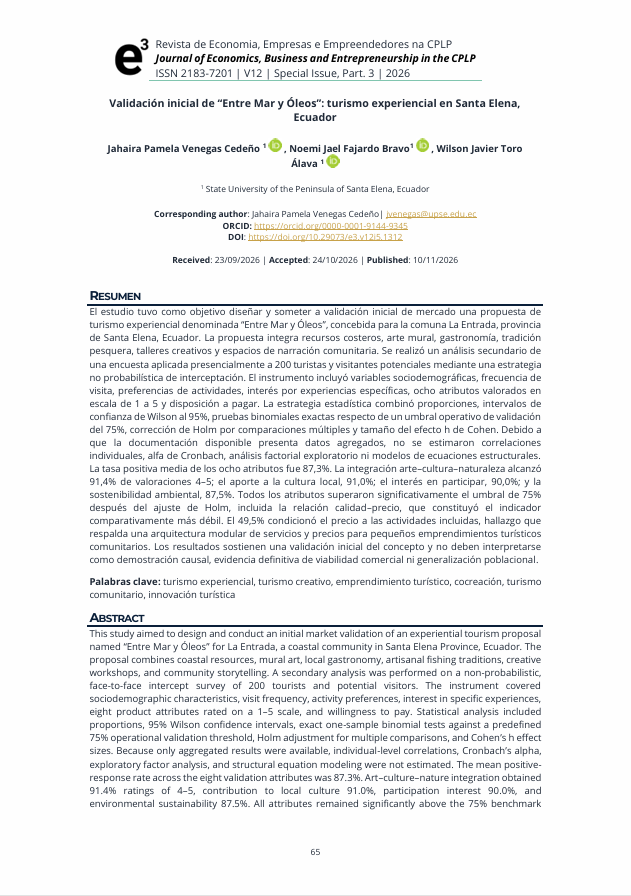
This study aimed to design and conduct an initial market validation of an experiential tourism proposal named “Entre Mar y Óleos” for La Entrada, a coastal community in Santa Elena Province, Ecuador. The proposal combines coastal resources, mural art, local gastronomy, artisanal fishing traditions, creative workshops, and community storytelling. A secondary analysis was performed on a non-probabilistic, face-to-face intercept survey of 200 tourists and potential visitors. The instrument covered sociodemographic characteristics, visit frequency, activity preferences, interest in specific experiences, eight product attributes rated on a 1–5 scale, and willingness to pay. Statistical analysis included proportions, 95% Wilson confidence intervals, exact one-sample binomial tests against a predefined 75% operational validation threshold, Holm adjustment for multiple comparisons, and Cohen’s h effect sizes. Because only aggregated results were available, individual-level correlations, Cronbach’s alpha, exploratory factor analysis, and structural equation modeling were not estimated. The mean positive-response rate across the eight validation attributes was 87.3%. Art–culture–nature integration obtained 91.4% ratings of 4–5, contribution to local culture 91.0%, participation interest 90.0%, and environmental sustainability 87.5%. All attributes remained significantly above the 75% benchmark after Holm correction; value for money was the comparatively weakest dimension. Nearly half of respondents (49.5%) stated that willingness to pay would depend on the activities included, supporting a modular service-and-price architecture for small community tourism enterprises. Findings support an initial concept validation and should not be interpreted as causal proof, definitive commercial viability, or population-level generalization.
Downloads
Article Details

This work is licensed under a Creative Commons Attribution 4.0 International License.
All articles published in e3 – Journal of Economics, Business and Entrepreneurship in the community of Portuguese-speaking countries are licensed under the Creative Commons Attribution (CC BY) license.
This license allows users to share (copy and redistribute the material in any medium or format) and adapt (remix, transform, and build upon the material) for any purpose, including commercial use, provided that appropriate credit is given to the original author(s) and the journal, a link to the license is provided, and any changes made are indicated.



References
Aschenbrand, E., Cisani, M., Meneghello, S., & Chance, J. (2025). Heritage and landscape narratives: How rural stereotypes are shaping UNESCO biosphere reserves. Tourism Geographies. https://doi.org/10.1080/14616688.2025.2581191
Berdugo Morantes, J. O., Torres Zamudio, M., & Bonilla Gómez, F. A. (2025). Innovation and sustainability in the value chain of the tourism sector in Boyacá. Sustainability, 17. https://doi.org/10.3390/su17209000
Dai, J., Fan, X., & Zhang, L. D. (2026). Digital intelligence and the inheritance of traditional culture: A glocalized model of intelligent heritage in Huangyan, China. Sustainability, 18. https://doi.org/10.3390/su18021062
Da Luz, E. C., Domareski-Ruiz, T. C., & De Souza Brum, A. L. (2025). Design thinking as an alternative for developing tourism solutions. Journal of Tourism and Development, 48. https://doi.org/10.34624/rtd.v48i0.35079
Dinh, T. H. A., Le, T. N. N., & Ho, H. T. T. (2025). Driving tourists’ destination choice intentions through innovation and destination image: A study from Vietnam. Global Business and Finance Review, 30(9), 67. https://doi.org/10.17549/gbfr.2025.30.9.67
Gao, Y., Zhan, S., & Yuan, D. (2026). Digital technology for cultural experience: A psychological ownership perspective on the three-path model. Sustainability, 18. https://doi.org/10.3390/su18020962
González-Sainz, Y., Ortiz-Pérez, O. L., Sánchez-Rodríguez, A., García-Vidal, G., Pérez-Campdesuñer, R., & Martínez-Vivar, R. (2026). Structural model of co-creation for tourism product design: Empirical validation in emerging destinations. SAGE Open, 16. https://doi.org/10.1177/21582440261463798
Lankauskienė, R., Simonaitytė, V., & Gedminaitė-Raudonė, Ž. (2025). Sustainable culinary tourism pathways in the Baltic Sea Region: A comparative perspective. Sustainability, 17. https://doi.org/10.3390/su172310472
Ozdemir, G., & Zonah, S. (2025). Revolutionising heritage interpretation with smart technologies: A blueprint for sustainable tourism. Sustainability, 17. https://doi.org/10.3390/su17104330
Petersen, C., Kelly, C., Merrell, I., Trapano, L., Wilkinson, T., Dobson, S., & Coles, T. (2025). Local businesses as boundary actors shaping sustainable tourism futures in biosphere reserves. Tourism Geographies. https://doi.org/10.1080/14616688.2025.2515090
Ramazanova, M., De Freitas, I. V., Castro, A. M., & Dentinho, T. P. (2025). Perceptions of residents of the North of Portugal on traditional gastronomy with a generalized Q analysis. Revista Portuguesa de Estudos Regionais, 72. https://doi.org/10.59072/rper.vi72.743
Ramos, C. M. Q., Serra, M., & Gonçalves, A. R. (2026). Sentiments and flavors: An approach to gastronomic innovation in the Algarve. Journal of Entrepreneurship, Management and Innovation. https://doi.org/10.7341/20262223
Shrestha, R. K., L'Espoir Decosta, J. N. P., & Whitford, M. (2025). Creating authentic Indigenous tourism experiences. Annals of Tourism Research, 110, 103882. https://doi.org/10.1016/j.annals.2024.103882
Suárez, M. A., Salas, E. L., Franco, I. C., & Sousa, A. Á. (2025). Towards a methodology of good practices for heritage-led rural regeneration: From the main paths to the surrounding areas. Cities, 162, 105849. https://doi.org/10.1016/j.cities.2025.105849
Sun, J.-J. (2026). Scenario co-creation: The paradigm shift in tourism resource development. Journal of Natural Resources, 41. https://doi.org/10.31497/zrzyxb.20260302
Tighazri, S., & Ibrahimi, G. (2026). Co-creating the touristic experience in the digital era: Towards increasing immersion or detachment. African Journal of Hospitality, Tourism and Leisure. https://doi.org/10.46222/ajhtl.19770720.763
Vélez-Ochoa, C. I., Muñoz-Sánchez, O., & Polo, O. C. C. (2025). From experience design to rural tourism: Empowerment and knowledge with Colombian coffee growers. Scientific Culture. https://doi.org/10.5281/zenodo.11325122
Zhai, J., & Li, X. (2026). A case study on integrating CAD and multimedia: Enhancing cultural immersion in tourism product design. Journal of Cases on Information Technology. https://doi.org/10.4018/JCIT.398955
Zhang, Z.-H., & Huang, H.-C. (2025). Enhancing sustainable tourism through virtual reality: The role of collectable experiences in well-being and meaning in life. Sustainability, 17. https://doi.org/10.3390/su17135809
Zhu, L., & Wang, Y. (2025). Technological innovation in promoting the sustainable development of tourist factories: Factors influencing tourists’ perceived value and loyalty in immersive VR experiences. Sustainability, 17. https://doi.org/10.3390/su17072871