
VALIDACIÓN INICIAL DE “ENTRE MAR Y ÓLEOS”: TURISMO EXPERIENCIAL EN SANTA ELENA, ECUADOR
Barra lateral del artículo
Contenido principal del artículo
Resumen
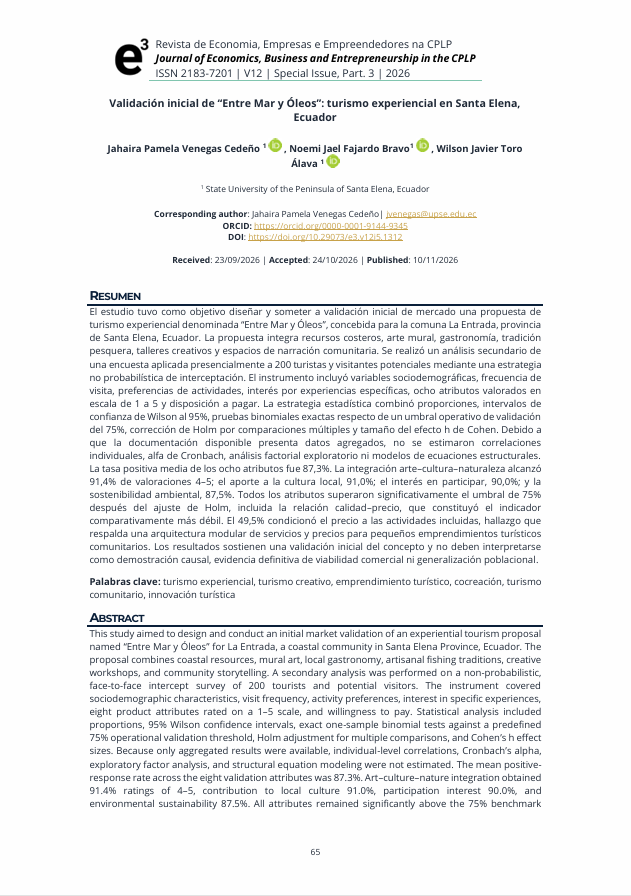
El estudio tuvo como objetivo diseñar y someter a validación inicial de mercado una propuesta de turismo experiencial denominada “Entre Mar y Óleos”, concebida para la comuna La Entrada, provincia de Santa Elena, Ecuador. La propuesta integra recursos costeros, arte mural, gastronomía, tradición pesquera, talleres creativos y espacios de narración comunitaria. Se realizó un análisis secundario de una encuesta aplicada presencialmente a 200 turistas y visitantes potenciales mediante una estrategia no probabilística de interceptación. El instrumento incluyó variables sociodemográficas, frecuencia de visita, preferencias de actividades, interés por experiencias específicas, ocho atributos valorados en escala de 1 a 5 y disposición a pagar. La estrategia estadística combinó proporciones, intervalos de confianza de Wilson al 95%, pruebas binomiales exactas respecto de un umbral operativo de validación del 75%, corrección de Holm por comparaciones múltiples y tamaño del efecto h de Cohen. Debido a que la documentación disponible presenta datos agregados, no se estimaron correlaciones individuales, alfa de Cronbach, análisis factorial exploratorio ni modelos de ecuaciones estructurales. La tasa positiva media de los ocho atributos fue 87,3%. La integración arte–cultura–naturaleza alcanzó 91,4% de valoraciones 4–5; el aporte a la cultura local, 91,0%; el interés en participar, 90,0%; y la sostenibilidad ambiental, 87,5%. Todos los atributos superaron significativamente el umbral de 75% después del ajuste de Holm, incluida la relación calidad–precio, que constituyó el indicador comparativamente más débil. El 49,5% condicionó el precio a las actividades incluidas, hallazgo que respalda una arquitectura modular de servicios y precios para pequeños emprendimientos turísticos comunitarios. Los resultados sostienen una validación inicial del concepto y no deben interpretarse como demostración causal, evidencia definitiva de viabilidad comercial ni generalización poblacional.
Descargas
Detalles del artículo

Esta obra está bajo una licencia internacional Creative Commons Atribución 4.0.
Todos los artículos publicados en la e3 – Revista de Economía, Empresas y Emprendimiento en la CPLP se distribuyen bajo la licencia Creative Commons Atribución (CC BY).
Esta licencia permite compartir (copiar y redistribuir el material en cualquier medio o formato) y adaptar (remezclar, transformar y crear a partir del material) para cualquier propósito, incluso comercial, siempre que se otorgue el crédito adecuado a los autores y a la revista, se proporcione un enlace a la licencia y se indiquen los cambios realizados.



Citas
Aschenbrand, E., Cisani, M., Meneghello, S., & Chance, J. (2025). Heritage and landscape narratives: How rural stereotypes are shaping UNESCO biosphere reserves. Tourism Geographies. https://doi.org/10.1080/14616688.2025.2581191
Berdugo Morantes, J. O., Torres Zamudio, M., & Bonilla Gómez, F. A. (2025). Innovation and sustainability in the value chain of the tourism sector in Boyacá. Sustainability, 17. https://doi.org/10.3390/su17209000
Dai, J., Fan, X., & Zhang, L. D. (2026). Digital intelligence and the inheritance of traditional culture: A glocalized model of intelligent heritage in Huangyan, China. Sustainability, 18. https://doi.org/10.3390/su18021062
Da Luz, E. C., Domareski-Ruiz, T. C., & De Souza Brum, A. L. (2025). Design thinking as an alternative for developing tourism solutions. Journal of Tourism and Development, 48. https://doi.org/10.34624/rtd.v48i0.35079
Dinh, T. H. A., Le, T. N. N., & Ho, H. T. T. (2025). Driving tourists’ destination choice intentions through innovation and destination image: A study from Vietnam. Global Business and Finance Review, 30(9), 67. https://doi.org/10.17549/gbfr.2025.30.9.67
Gao, Y., Zhan, S., & Yuan, D. (2026). Digital technology for cultural experience: A psychological ownership perspective on the three-path model. Sustainability, 18. https://doi.org/10.3390/su18020962
González-Sainz, Y., Ortiz-Pérez, O. L., Sánchez-Rodríguez, A., García-Vidal, G., Pérez-Campdesuñer, R., & Martínez-Vivar, R. (2026). Structural model of co-creation for tourism product design: Empirical validation in emerging destinations. SAGE Open, 16. https://doi.org/10.1177/21582440261463798
Lankauskienė, R., Simonaitytė, V., & Gedminaitė-Raudonė, Ž. (2025). Sustainable culinary tourism pathways in the Baltic Sea Region: A comparative perspective. Sustainability, 17. https://doi.org/10.3390/su172310472
Ozdemir, G., & Zonah, S. (2025). Revolutionising heritage interpretation with smart technologies: A blueprint for sustainable tourism. Sustainability, 17. https://doi.org/10.3390/su17104330
Petersen, C., Kelly, C., Merrell, I., Trapano, L., Wilkinson, T., Dobson, S., & Coles, T. (2025). Local businesses as boundary actors shaping sustainable tourism futures in biosphere reserves. Tourism Geographies. https://doi.org/10.1080/14616688.2025.2515090
Ramazanova, M., De Freitas, I. V., Castro, A. M., & Dentinho, T. P. (2025). Perceptions of residents of the North of Portugal on traditional gastronomy with a generalized Q analysis. Revista Portuguesa de Estudos Regionais, 72. https://doi.org/10.59072/rper.vi72.743
Ramos, C. M. Q., Serra, M., & Gonçalves, A. R. (2026). Sentiments and flavors: An approach to gastronomic innovation in the Algarve. Journal of Entrepreneurship, Management and Innovation. https://doi.org/10.7341/20262223
Shrestha, R. K., L'Espoir Decosta, J. N. P., & Whitford, M. (2025). Creating authentic Indigenous tourism experiences. Annals of Tourism Research, 110, 103882. https://doi.org/10.1016/j.annals.2024.103882
Suárez, M. A., Salas, E. L., Franco, I. C., & Sousa, A. Á. (2025). Towards a methodology of good practices for heritage-led rural regeneration: From the main paths to the surrounding areas. Cities, 162, 105849. https://doi.org/10.1016/j.cities.2025.105849
Sun, J.-J. (2026). Scenario co-creation: The paradigm shift in tourism resource development. Journal of Natural Resources, 41. https://doi.org/10.31497/zrzyxb.20260302
Tighazri, S., & Ibrahimi, G. (2026). Co-creating the touristic experience in the digital era: Towards increasing immersion or detachment. African Journal of Hospitality, Tourism and Leisure. https://doi.org/10.46222/ajhtl.19770720.763
Vélez-Ochoa, C. I., Muñoz-Sánchez, O., & Polo, O. C. C. (2025). From experience design to rural tourism: Empowerment and knowledge with Colombian coffee growers. Scientific Culture. https://doi.org/10.5281/zenodo.11325122
Zhai, J., & Li, X. (2026). A case study on integrating CAD and multimedia: Enhancing cultural immersion in tourism product design. Journal of Cases on Information Technology. https://doi.org/10.4018/JCIT.398955
Zhang, Z.-H., & Huang, H.-C. (2025). Enhancing sustainable tourism through virtual reality: The role of collectable experiences in well-being and meaning in life. Sustainability, 17. https://doi.org/10.3390/su17135809
Zhu, L., & Wang, Y. (2025). Technological innovation in promoting the sustainable development of tourist factories: Factors influencing tourists’ perceived value and loyalty in immersive VR experiences. Sustainability, 17. https://doi.org/10.3390/su17072871