DESIGNING DESTINATIONS, COMMUNICATING EXPERIENCES: THE CASE OF PORTUGUESE REGIONAL TOURISM ORGANISATIONS ON INSTAGRAM
Barra lateral del artículo
Contenido principal del artículo
Resumen
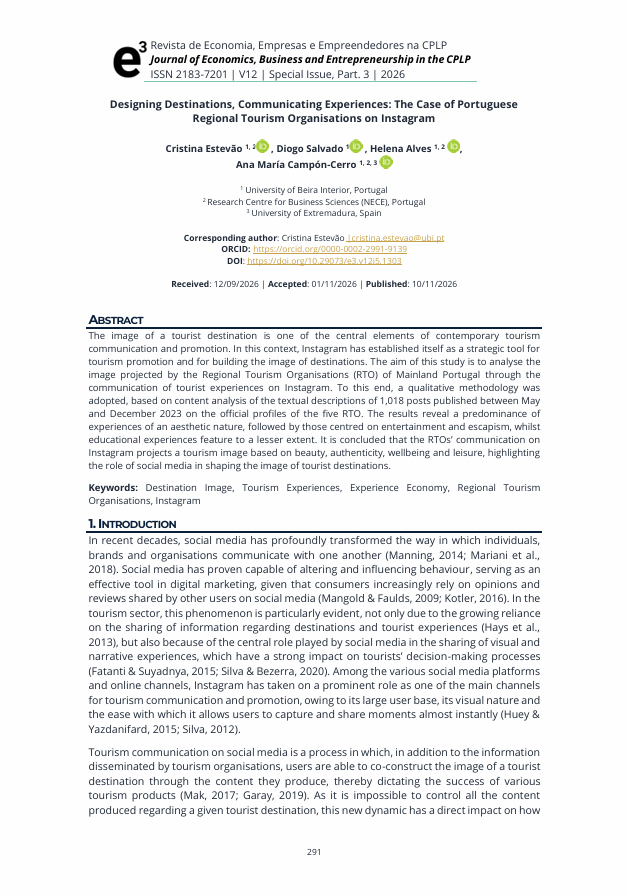
The image of a tourist destination is one of the central elements of contemporary tourism communication and promotion. In this context, Instagram has established itself as a strategic tool for tourism promotion and for building the image of destinations. The aim of this study is to analyse the image projected by the Regional Tourism Organisations (RTO) of Mainland Portugal through the communication of tourist experiences on Instagram. To this end, a qualitative methodology was adopted, based on content analysis of the textual descriptions of 1,018 posts published between May and December 2023 on the official profiles of the five RTO. The results reveal a predominance of experiences of an aesthetic nature, followed by those centred on entertainment and escapism, whilst educational experiences feature to a lesser extent. It is concluded that the RTOs’ communication on Instagram projects a tourism image based on beauty, authenticity, wellbeing and leisure, highlighting the role of social media in shaping the image of tourist destinations.
Descargas
Detalles del artículo

Esta obra está bajo una licencia internacional Creative Commons Atribución 4.0.
Todos los artículos publicados en la e3 – Revista de Economía, Empresas y Emprendimiento en la CPLP se distribuyen bajo la licencia Creative Commons Atribución (CC BY).
Esta licencia permite compartir (copiar y redistribuir el material en cualquier medio o formato) y adaptar (remezclar, transformar y crear a partir del material) para cualquier propósito, incluso comercial, siempre que se otorgue el crédito adecuado a los autores y a la revista, se proporcione un enlace a la licencia y se indiquen los cambios realizados.



Datos de los fondos
Citas
Antolín-Prieto, R., Sarmiento-Guede, J., & Antonovica, A. (2021). Instagram as a value co-creation tool for the image of tourist destination. Analysis of the case of Spain during COVID-19: The Balearic and the Canary Islands. Espacios, 42(12), 79–93. https://doi.org/10.48082/espacios-a21v42n12p07
Aroeira, T., Dantas, A. C., & de Sevilha Gosling, M. (2016). Experiência turística memorável, percepção cognitiva, reputação e lealdade ao destino: Um modelo empírico. Turismo: Visão e Ação, 18(3), 584–610. https://doi.org/10.14210/rtva.v18n3.p584-610
Bardin, L. (2009). Análise de conteúdo. Edições 70.
Beerli, A., & Martín, J. (2004). Factors influencing destination image. Annals of Tourism Research, 31(3), 657–681. https://doi.org/10.1016/j.annals.2004.01.010
Cardona, C., & María-Dolores, S. (2017). Análisis de la actividad y presencia en Facebook y otras redes sociales de los portales turísticos de las comunidades autónomas españolas. Cuadernos de Turismo, 39, 239–264. https://doi.org/10.17979/rotur.2016.11.1.1779
Corrêa, C., Alves, H., & Estevão, C. (2025). Adapting tourism promotion during crisis: A visual content analysis of Portugal's Instagram strategy amid Covid-19. Revista Investigaciones Turísticas, 30, 209–237. https://doi.org/10.14198/INTURI.26701
Chen, J., Huang, Y., Wu, E. Q., Ip, R., & Wang, K. (2022). How does rural tourism experience affect green consumption in terms of memorable rural-based tourism experiences, connectedness to nature and environmental awareness? Journal of Hospitality and Tourism Management, 54, 166–177. https://doi.org/10.1016/j.jhtm.2022.12.006
Crick-Furman, D., & Prentice, R. (2000). Modeling tourists’ multiple values. Annals of Tourism Research, 27(1), 69–92. https://doi.org/10.1016/S0160-7383(99)00041-9
De Jesús Santos, C., Campos, A., & De Jesus Barbosa, F. (2020). O Instagram como ferramenta promocional em agências de receptivo em Aracaju/Sergipe, Brasil. TURYDES: Revista sobre Turismo y Desarrollo Local Sostenible, 13(28), 135–154. https://dialnet.unirioja.es/descarga/articulo/7740372.pdf
Fatanti, M., & Suyadnya, I. (2015). Beyond user gaze: How Instagram creates tourism destination brand? Procedia - Social and Behavioral Sciences, 211, 1089–1095. https://doi.org/10.1016/j.sbspro.2015.11.145
Fiona, F., Sugeng, S., Nasution, & Putri, A. M. (2022). Digital marketing through social media Instagram as a promotion means to increase interest in visiting Bengkulu tourism objects. Advances in Economics, Business and Management Research. https://doi.org/10.2991/aebmr.k.220304.009
Garay, L. (2019). #Visitspain: Breaking down affective and cognitive attributes in the social media construction of the tourist destination image. Tourism Management Perspectives, 32, Article 100560. https://doi.org/10.1016/j.tmp.2019.100560
Garrod, B., & Dowell, D. (2020). Experiential marketing of an underground tourist attraction. Tourism and Hospitality, 1(1), 1–19. https://doi.org/10.3390/tourhosp1010001
Gorji, A., Almeida-García, F., & Melé, P. (2023). Analysis of the projected image of tourism destinations on photographs: The case of Iran on Instagram. Anatolia, 34(2). https://doi.org/10.1080/13032917.2021.2001665
Hays, S., Page, S., & Buhalis, D. (2013). Social media as a destination marketing tool: Its use by national tourism organisations. Current Issues in Tourism, 16(3), 211–239. https://doi.org/10.1080/13683500.2012.662215
Hosany, S., & Witham, M. (2009). Dimensions of cruisers’ experiences, satisfaction, and intention to recommend. Journal of Travel Research, 49(3), 351–364. https://doi.org/10.1177/0047287509346859
Hosany, S., Sthapit, E., & Björk, P. (2022). Memorable tourism experience: A review and research agenda. Psychology & Marketing, 39(8), 1467–1486. https://doi.org/10.1002/mar.21665
Huey, L. X., & Yazdanifard, R. (2015). How Instagram can be used as a tool in social network marketing. International Journal of Management, Accounting and Economics, 2(9), 1135–1144.
Jacinto, M. M. P. L. (2023). Meios de comunicação e imagem dos destinos turísticos: Uma revisão de literatura. Revista Internacional em Língua Portuguesa, 44, 13–27. https://doi.org/10.31492/2184-2043.rilp2023.44/pp.13-27
Jaramillo, F., Jaramillo, N., Jaramillo, J., & Paredes, M. (2023). Las redes sociales como medio de difusión de atractivos turísticos de la parroquia de Lloa. LATAM Revista Latinoamericana de Ciencias Sociales y Humanidades, 4(2), 2937–2943. https://doi.org/10.56712/latam.v4i2.80
Kannan, P., & Li, H. (2017). Digital marketing: A framework, review and research agenda. International Journal of Research in Marketing, 34(1), 22–45. https://doi.org/10.1016/j.ijresmar.2016.11.006
Kim, J., & Ritchie, J. (2013). Cross-cultural validation of a memorable tourism experience scale (MTES). Journal of Travel Research, 53(3), 323–335. https://doi.org/10.1177/0047287513496468
Kotler, P., Kartajaya, H., & Setiawan, I. (2016). Marketing 4.0: Moving from traditional to digital. John Wiley & Sons.
Kutlu, D., & Ayyıldız, H. (2021). The role of the destination image in creating memorable tourism experience. Journal of Tourism and Services, 12(23), 199–216. https://doi.org/10.29036/jots.v12i23.303
Lane, B., Kastenholz, E., & Carneiro, M. J. (2022). Rural tourism and sustainability: A special issue, review and update for the opening years of the twenty-first century. Sustainability, 14(10), Article 6070. https://doi.org/10.3390/su14106070
Mak, A. H. (2017). Online destination image: Comparing national tourism organisation’s and tourists’ perspectives. Tourism Management, 60, 280–297. https://doi.org/10.1016/j.tourman.2016.12.012
Mangold, W., & Faulds, D. (2009). Social media: The new hybrid element of the promotion mix. Business Horizons, 52(4), 357–365. https://doi.org/10.1016/j.bushor.2009.03.002
Manning, J. (2014). Social media, definition and classes of. In K. Harvey (Ed.), Encyclopedia of social media and politics (pp. 1158–1162). SAGE Publications.
Mariani, M., Mura, M., & Di Felice, M. (2018). The determinants of Facebook social engagement for national tourism organizations’ Facebook pages: A quantitative approach. Journal of Destination Marketing & Management, 8, 312–325. https://doi.org/10.1016/j.jdmm.2017.06.003
Mehmetoglu, M., & Engen, M. (2011). Pine and Gilmore’s concept of experience economy and its dimensions: An empirical examination in tourism. Journal of Quality Assurance in Hospitality & Tourism, 12(4), 237–255. https://doi.org/10.1080/1528008X.2011.541847
Michaelidou, N., Siamagka, N., Moraes, C., & Micevski, M. (2013). Do marketers use visual representations of destinations that tourists value? Comparing visitors’ image of a destination with marketer-controlled images online. Journal of Travel Research, 52(6), 789–804. https://doi.org/10.1177/0047287513481272
Minazzi, R. (2015). Social media marketing in tourism and hospitality. Springer. https://doi.org/10.1007/978-3-319-05182-6
Neuendorf, K. (2017). The content analysis guidebook. SAGE Publications. https://doi.org/10.4135/9781071802878
Mossberg, L. (2003). Att skapa upplevelser: Från OK till WOW!. Studentlitteratur AB.
Nodari, F., Soares, M., Wiedenhoft, G., & Oliveira, M. (2014). Contribuição do MAXQDA e do NVivo para a realização da análise de conteúdo. In Anais do XXXVIII Encontro da ANPAD. Associação Nacional de Pós-Graduação e Pesquisa em Administração.
Oh, H., Fiore, A. M., & Jeoung, M. (2007). Measuring experience economy concepts: Tourism applications. Journal of Travel Research, 46(2), 119–132. https://doi.org/10.1177/0047287507304039
Osmond, A., Chen, T., & Pearce, P. (2015b). Examining experience economy approaches to tourists’ anticipated experiences: Mainland Chinese travellers consider Australia. European Journal of Tourism Research, 10, 95–108. https://doi.org/10.54055/ejtr.v10i.181
Pan, S., Lee, J., & Tsai, H. (2013). Travel photos: Motivations, image dimensions, and affective qualities of places. Tourism Management, 40, 59–69. https://doi.org/10.1016/j.tourman.2013.05.007
Parra-López, E., Bulchand-Gidumal, J., Taño, D. G., & Armas, R. J. D. (2011). Intentions to use social media in organizing and taking vacation trips. Computers in Human Behavior, 27(2), 640–654. https://doi.org/10.1016/j.chb.2010.05.022
Pine, B., & Gilmore, J. H. (1998). Welcome to the experience economy. Harvard Business Review, 76(4), 97–105.
Rasoolimanesh, S., Seyfi, S., Hall, C., & Hatamifar, P. (2021). Understanding memorable tourism experiences and behavioural intentions of heritage tourists. Journal of Destination Marketing & Management, 21, Article 100621. https://doi.org/10.1016/j.jdmm.2021.100621
Şeker, F., & Unur, K. (2022). The experience economy analysis of distinct destinations. Journal of Multidisciplinary Academic Tourism, 7(2), 31–43. https://doi.org/10.31822/jomat.2022-7-2-31
Selltiz, C., Wrightsman, L. S., & Cook, S. W. (1976). Research methods in social relations (3rd ed.). Holt, Rinehart and Winston.
Silva, A. (2012). Dinâmicas comunicacionais na vida cotidiana – Instagram: Um modo de narrar sobre si, fotografar ou de olhar pra se ver. In Anais do XVII Congresso de Ciências da Comunicação na Região Sudeste. Intercom – Sociedade Brasileira de Estudos Interdisciplinares da Comunicação.
Silva, C., Kastenholz, E., & Abrantes, J. L. (2018). A imagem da Serra da Estrela na perspetiva dos turistas. In A. Correia & P. B. Homem (Coords.), Turismo no Centro de Portugal: Potencialidades e tendências (pp. 281–298). Actual Editora.
Silva, F., & Bezerra, L. (2020). O Instagram como ferramenta de disseminação do turismo no destino Brasil. Revista Turismo & Cidades, 2(4), 56–75. https://periodicoseletronicos.ufma.br/index.php/turismoecidades/article/view/13888
Torres, C. (2009). A Bíblia do marketing digital. Novatec Editora.
Turismo de Portugal. (2017). Estratégia Turismo 2027. https://www.turismodeportugal.pt/pt/Turismo_Portugal/Estrategia/Estrategia_2027/Paginas/default.aspx
Zhang, H., Wu, Y., & Buhalis, D. (2018). A model of perceived image, memorable tourism experiences and revisit intention. Journal of Destination Marketing & Management, 8, 326–336. https://doi.org/10.1016/j.jdmm.2017.06.004