RESIDENTS SUPPORTING MEGA-EVENTS: THE CASE OF COLDPLAY CONCERTS
Article Sidebar
Main Article Content
Abstract
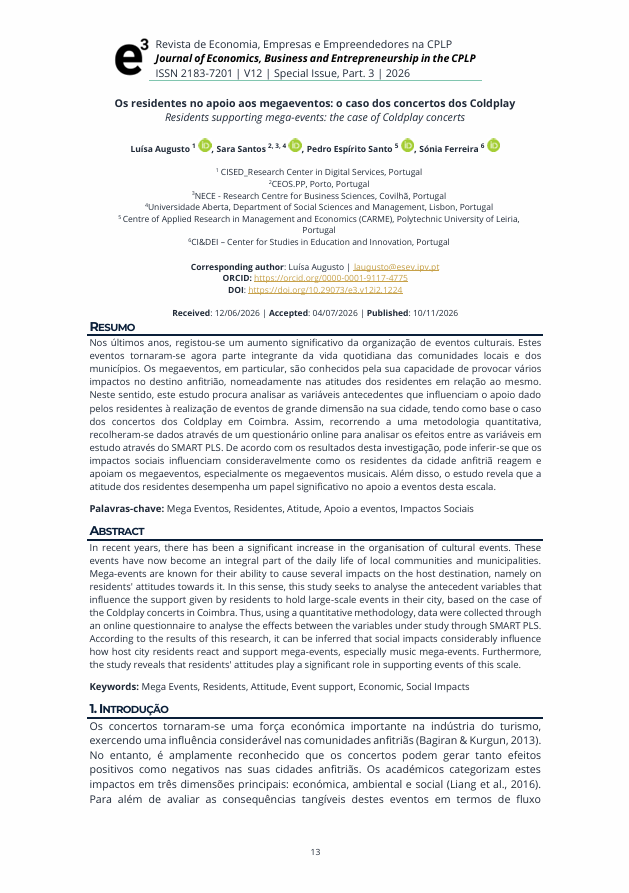
In recent years, there has been a significant increase in the organisation of cultural events. These events have now become an integral part of the daily life of local communities and municipalities. Mega-events are known for their ability to cause several impacts on the host destination, namely on residents' attitudes towards it. In this sense, this study seeks to analyse the antecedent variables that influence the support given by residents to hold large-scale events in their city, based on the case of the Coldplay concerts in Coimbra. Thus, using a quantitative methodology, data were collected through an online questionnaire to analyse the effects between the variables under study through SMART PLS. According to the results of this research, it can be inferred that social impacts considerably influence how host city residents react and support mega-events, especially music mega-events. Furthermore, the study reveals that residents' attitudes play a significant role in supporting events of this scale.
Downloads
Article Details

This work is licensed under a Creative Commons Attribution 4.0 International License.
All articles published in e3 – Journal of Economics, Business and Entrepreneurship in the community of Portuguese-speaking countries are licensed under the Creative Commons Attribution (CC BY) license.
This license allows users to share (copy and redistribute the material in any medium or format) and adapt (remix, transform, and build upon the material) for any purpose, including commercial use, provided that appropriate credit is given to the original author(s) and the journal, a link to the license is provided, and any changes made are indicated.



References
Agência Lusa. (2023, June 29). Concertos dos Coldplay em Coimbra geraram retorno económico direto de 36 milhões de euros. Observador. https://observador.pt/2023/06/30/concertos-dos-coldplay-em-coimbra-geraram-retorno-economico-direto-de-36-milhoes-de-euros/
Andereck, K. L., & Vogt, C. A. (2000). The relationship between residents’ attitudes toward tourism and tourism development options. Journal of Travel Research, 39(1), 27–36. https://doi.org/10.1177/004728750003900104
Bagiran, D., & Kurgun, H. (2013). Research on social impacts of the Foça Rock Festival: The validity of the Festival Social Impact Attitude Scale. Current Issues in Tourism, 19(9), 930–948. https://doi.org/10.1080/13683500.2013.800028
Barclay, D., Higgins, C., & Thompson, R. (1995). The partial least squares (PLS) approach to causal modeling: Personal computer adoption and use as an illustration. Technology Studies, 2(2), 285–309.
Boonsiritomachai, W., & Phonthanukitithaworn, C. (2019). Residents’ support for sports events tourism development in beach city: The role of community participation and tourism impacts. SAGE Open, 9(2), 215824401984341. https://doi.org/10.1177/2158244019843417
Deccio, C., & Baloglu, S. (2002). Nonhost community resident reactions to the 2002 Winter Olympics: The spillover impacts. Journal of Travel Research, 41(1), 46–56. https://doi.org/10.1177/0047287502041001006
Dwyer, L., Forsyth, P., & Spurr, R. (2006). Assessing the economic impacts of events: A computable general equilibrium approach. Journal of Travel Research, 45(1), 59–66. https://doi.org/10.1177/0047287506288907
Fornell, C., & Larcker, D. F. (1981). Evaluating structural equation models with unobservable variables and measurement error. Journal of Marketing Research, 18, 39–50.
Gursoy, D., & Kendall, K. W. (2006). Hosting mega-events. Annals of Tourism Research, 33(3), 603–623. https://doi.org/10.1016/j.annals.2006.01.005
Hair, J. F., Hult, G. T. M., Ringle, C. M., & Sarstedt, M. (2017). A primer on partial least squares structural equation modeling (PLS-SEM). SAGE.
Kim, H. J., Gursoy, D., & Lee, S. (2006). The impact of the 2002 World Cup on South Korea: Comparisons of pre- and post-games. Tourism Management, 27(1), 86–96. https://doi.org/10.1016/j.tourman.2004.07.010
Kim, J., Han, J., Kim, E., & Kim, C. (2022). Quality of life, subjective expectations, and exchange from hosting mega-events. Sustainability, 14(17), 11079. https://doi.org/10.3390/su141711079
Kim, S. S., & Petrick, J. F. (2005). Residents’ perceptions on impacts of the FIFA 2002 World Cup: The case of Seoul as a host city. Tourism Management, 26(1), 25–38. https://doi.org/10.1016/j.tourman.2003.09.013
Lee, Y., Kim, S. Y., Lee, C., & Kim, S. (2014). The impact of a mega event on visitors’ attitude toward hosting destination: Using trust transfer theory. Journal of Travel & Tourism Marketing, 31(4), 507–521. https://doi.org/10.1080/10548408.2014.883347
Liang, Y., Wang, C., Tsaur, S., Yen, C., & Tu, J. (2016). Mega-event and urban sustainable development. International Journal of Event and Festival Management, 7(3), 152–171. https://doi.org/10.1108/IJEFM-05-2016-0033
Lim, S., & Lee, J. (2006). Host population perceptions of the impact of mega-events. Asia Pacific Journal of Tourism Research. https://doi.org/10.1080/10941660600931259
Müller, M. (2015). What makes an event a mega-event? Definitions and sizes. Leisure Studies, 34(6), 627–642. https://doi.org/10.1080/02614367.2014.993333
Pavluković, V., Armenski, T., & Alcántara-Pilar, J. M. (2017). Social impacts of music festivals: Does culture impact locals’ attitudes toward events in Serbia and Hungary? Tourism Management, 63, 42–53. https://doi.org/10.1016/j.tourman.2017.06.006
Prayag, G., Hosany, S., Nunkoo, R., & Alders, T. (2013). London residents’ support for the 2012 Olympic Games: The mediating effect of overall attitude. Tourism Management, 36, 629–640. https://doi.org/10.1016/j.tourman.2012.08.003
Ritchie, J. R. B. (1984). Assessing the impact of hallmark events: Conceptual and research issues. Journal of Travel Research, 23(1), 2–11. https://doi.org/10.1177/004728758402300101
Roche, M. J. (1994). Mega-events and urban policy. Annals of Tourism Research, 21(1), 1–19. https://doi.org/10.1016/0160-7383(94)90002-7
Touring Data. (2023, June 27). Music of the Spheres Tour. Touring Data. https://touringdata.wordpress.com/2022/04/19/coldplay-music-of-the-spheres-tour/
Xu, Z., Wu, C., & Li, X. (2022). Residents’ perceptions and behavioral intentions towards mega-sports events: A case study of Beijing 2022 Olympic Winter Games. Sustainability, 14(22), 14955. https://doi.org/10.3390/su142214955
Zhou, Y., & Ap, J. (2008). Residents’ perceptions towards the impacts of the Beijing 2008 Olympic Games. Journal of Travel Research, 48(1), 78–91. https://doi.org/10.1177/0047287508328792