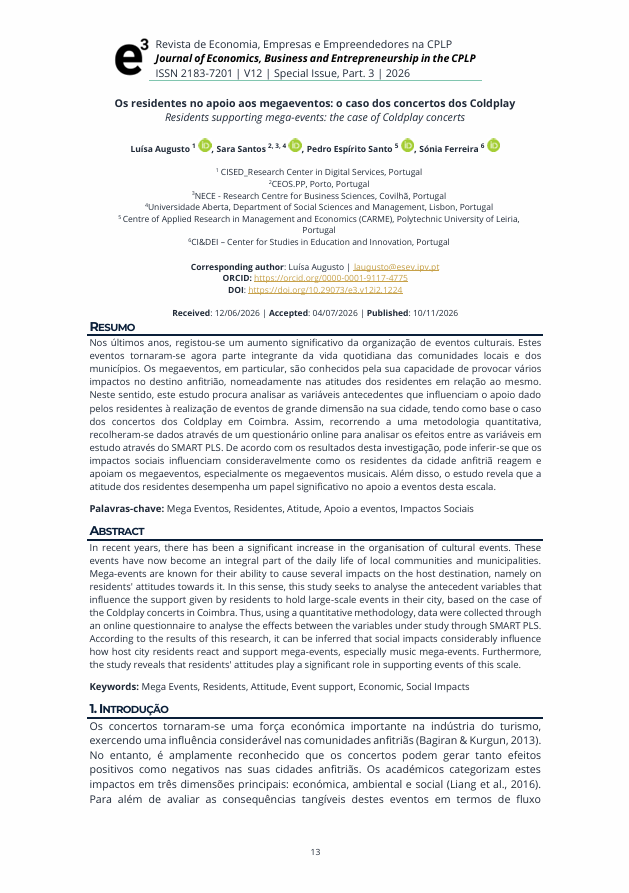
OS RESIDENTES NO APOIO AOS MEGAEVENTOS: O CASO DOS CONCERTOS DOS COLDPLAY
Barra lateral del artículo
Contenido principal del artículo
Resumen
En los últimos años, registramos un aumento significativo en la organización de eventos culturales. Estos eventos tornaram-se agora parte integrante da vida cotidiana das comunidades locais y dos municípios. Los megaeventos, en particular, son conocidos por su capacidad de provocar varios impactos en el destino anfitrião, principalmente en las actitudes de los residentes en relación con el mesmo. En este sentido, este estudio procura analizar los diversos antecedentes que influyeron en el apoyo dado por los residentes en la realización de eventos de gran dimensión en su ciudad, teniendo como base el caso de los conciertos de Coldplay en Coimbra. Así, recordando una metodología cuantitativa, recorremos datos a través de un cuestionario en línea para analizar los efectos entre las variaciones en los estudios a través de SMART PLS. De acuerdo con los resultados de esta investigación, se puede inferir que los impactos sociales influyen consideradamente como los residentes de la ciudad anfitriã reagem y apoiam los megaeventos, especialmente los megaeventos musicales. Además, el estudio revela que la actitud de los residentes desempenha un papel significativo en el apoyo a eventos de esta escala.
Descargas
Detalles del artículo

Esta obra está bajo una licencia internacional Creative Commons Atribución 4.0.
Todos los artículos publicados en la e3 – Revista de Economía, Empresas y Emprendimiento en la CPLP se distribuyen bajo la licencia Creative Commons Atribución (CC BY).
Esta licencia permite compartir (copiar y redistribuir el material en cualquier medio o formato) y adaptar (remezclar, transformar y crear a partir del material) para cualquier propósito, incluso comercial, siempre que se otorgue el crédito adecuado a los autores y a la revista, se proporcione un enlace a la licencia y se indiquen los cambios realizados.



Citas
Agência Lusa. (2023, June 29). Concertos dos Coldplay em Coimbra geraram retorno económico direto de 36 milhões de euros. Observador. https://observador.pt/2023/06/30/concertos-dos-coldplay-em-coimbra-geraram-retorno-economico-direto-de-36-milhoes-de-euros/
Andereck, K. L., & Vogt, C. A. (2000). The relationship between residents’ attitudes toward tourism and tourism development options. Journal of Travel Research, 39(1), 27–36. https://doi.org/10.1177/004728750003900104
Bagiran, D., & Kurgun, H. (2013). Research on social impacts of the Foça Rock Festival: The validity of the Festival Social Impact Attitude Scale. Current Issues in Tourism, 19(9), 930–948. https://doi.org/10.1080/13683500.2013.800028
Barclay, D., Higgins, C., & Thompson, R. (1995). The partial least squares (PLS) approach to causal modeling: Personal computer adoption and use as an illustration. Technology Studies, 2(2), 285–309.
Boonsiritomachai, W., & Phonthanukitithaworn, C. (2019). Residents’ support for sports events tourism development in beach city: The role of community participation and tourism impacts. SAGE Open, 9(2), 215824401984341. https://doi.org/10.1177/2158244019843417
Deccio, C., & Baloglu, S. (2002). Nonhost community resident reactions to the 2002 Winter Olympics: The spillover impacts. Journal of Travel Research, 41(1), 46–56. https://doi.org/10.1177/0047287502041001006
Dwyer, L., Forsyth, P., & Spurr, R. (2006). Assessing the economic impacts of events: A computable general equilibrium approach. Journal of Travel Research, 45(1), 59–66. https://doi.org/10.1177/0047287506288907
Fornell, C., & Larcker, D. F. (1981). Evaluating structural equation models with unobservable variables and measurement error. Journal of Marketing Research, 18, 39–50.
Gursoy, D., & Kendall, K. W. (2006). Hosting mega-events. Annals of Tourism Research, 33(3), 603–623. https://doi.org/10.1016/j.annals.2006.01.005
Hair, J. F., Hult, G. T. M., Ringle, C. M., & Sarstedt, M. (2017). A primer on partial least squares structural equation modeling (PLS-SEM). SAGE.
Kim, H. J., Gursoy, D., & Lee, S. (2006). The impact of the 2002 World Cup on South Korea: Comparisons of pre- and post-games. Tourism Management, 27(1), 86–96. https://doi.org/10.1016/j.tourman.2004.07.010
Kim, J., Han, J., Kim, E., & Kim, C. (2022). Quality of life, subjective expectations, and exchange from hosting mega-events. Sustainability, 14(17), 11079. https://doi.org/10.3390/su141711079
Kim, S. S., & Petrick, J. F. (2005). Residents’ perceptions on impacts of the FIFA 2002 World Cup: The case of Seoul as a host city. Tourism Management, 26(1), 25–38. https://doi.org/10.1016/j.tourman.2003.09.013
Lee, Y., Kim, S. Y., Lee, C., & Kim, S. (2014). The impact of a mega event on visitors’ attitude toward hosting destination: Using trust transfer theory. Journal of Travel & Tourism Marketing, 31(4), 507–521. https://doi.org/10.1080/10548408.2014.883347
Liang, Y., Wang, C., Tsaur, S., Yen, C., & Tu, J. (2016). Mega-event and urban sustainable development. International Journal of Event and Festival Management, 7(3), 152–171. https://doi.org/10.1108/IJEFM-05-2016-0033
Lim, S., & Lee, J. (2006). Host population perceptions of the impact of mega-events. Asia Pacific Journal of Tourism Research. https://doi.org/10.1080/10941660600931259
Müller, M. (2015). What makes an event a mega-event? Definitions and sizes. Leisure Studies, 34(6), 627–642. https://doi.org/10.1080/02614367.2014.993333
Pavluković, V., Armenski, T., & Alcántara-Pilar, J. M. (2017). Social impacts of music festivals: Does culture impact locals’ attitudes toward events in Serbia and Hungary? Tourism Management, 63, 42–53. https://doi.org/10.1016/j.tourman.2017.06.006
Prayag, G., Hosany, S., Nunkoo, R., & Alders, T. (2013). London residents’ support for the 2012 Olympic Games: The mediating effect of overall attitude. Tourism Management, 36, 629–640. https://doi.org/10.1016/j.tourman.2012.08.003
Ritchie, J. R. B. (1984). Assessing the impact of hallmark events: Conceptual and research issues. Journal of Travel Research, 23(1), 2–11. https://doi.org/10.1177/004728758402300101
Roche, M. J. (1994). Mega-events and urban policy. Annals of Tourism Research, 21(1), 1–19. https://doi.org/10.1016/0160-7383(94)90002-7
Touring Data. (2023, June 27). Music of the Spheres Tour. Touring Data. https://touringdata.wordpress.com/2022/04/19/coldplay-music-of-the-spheres-tour/
Xu, Z., Wu, C., & Li, X. (2022). Residents’ perceptions and behavioral intentions towards mega-sports events: A case study of Beijing 2022 Olympic Winter Games. Sustainability, 14(22), 14955. https://doi.org/10.3390/su142214955
Zhou, Y., & Ap, J. (2008). Residents’ perceptions towards the impacts of the Beijing 2008 Olympic Games. Journal of Travel Research, 48(1), 78–91. https://doi.org/10.1177/0047287508328792