THE “MEMO” TEACHING METHOD FOR SQUARING THE CIRCLE
Article Sidebar
Main Article Content
Abstract
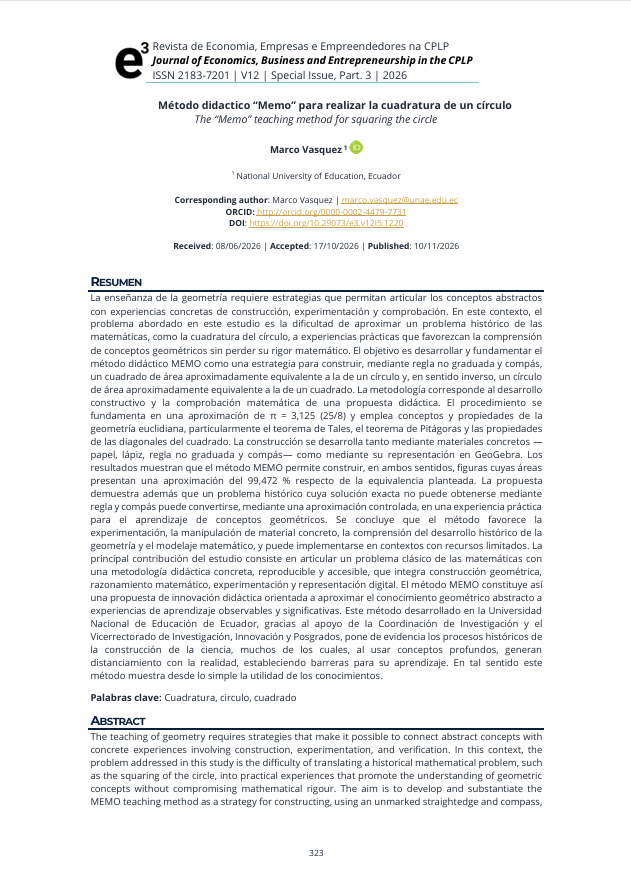
The teaching of geometry requires strategies that make it possible to connect abstract concepts with concrete experiences involving construction, experimentation, and verification. In this context, the problem addressed in this study is the difficulty of translating a historical mathematical problem, such as the squaring of the circle, into practical experiences that promote the understanding of geometric concepts without compromising mathematical rigour. The aim is to develop and substantiate the MEMO teaching method as a strategy for constructing, using an unmarked straightedge and compass, a square whose area is approximately equivalent to that of a circle and, conversely, a circle whose area is approximately equivalent to that of a square. The methodology involves the constructive development and mathematical verification of a teaching proposal. The procedure is based on an approximation of π = 3.125 (25/8) and employs concepts and properties of Euclidean geometry, particularly Thales' theorem, the Pythagorean theorem, and the properties of the diagonals of a square. The construction is carried out both using physical materials—paper, pencil, an unmarked straightedge, and compass—and through its representation in GeoGebra. The results show that the MEMO method makes it possible to construct figures in both directions whose areas achieve an approximation of 99.472% of the proposed equivalence. The proposal also demonstrates that a historical problem whose exact solution cannot be obtained using a straightedge and compass can be transformed, through a controlled approximation, into a practical experience for learning geometric concepts. It is concluded that the method promotes experimentation, the manipulation of concrete materials, an understanding of the historical development of geometry, and mathematical modelling, and can be implemented in contexts with limited resources. The main contribution of this study lies in connecting a classical mathematical problem with a concrete, reproducible, and accessible teaching methodology that integrates geometric construction, mathematical reasoning, experimentation, and digital representation. The MEMO method thus constitutes an innovative teaching approach aimed at bringing abstract geometric knowledge closer to observable and meaningful learning experiences. This method, developed at the National University of Education of Ecuador with the support of the Research Coordination Office and the Vice-Rectorate for Research, Innovation and Postgraduate Studies, highlights the historical processes involved in the construction of scientific knowledge. Many of these processes, because they rely on complex concepts, can become disconnected from reality, thereby creating barriers to learning. In this regard, the method demonstrates, through simple approaches, the practical value of knowledge.
Downloads
Article Details

This work is licensed under a Creative Commons Attribution 4.0 International License.
All articles published in e3 – Journal of Economics, Business and Entrepreneurship in the community of Portuguese-speaking countries are licensed under the Creative Commons Attribution (CC BY) license.
This license allows users to share (copy and redistribute the material in any medium or format) and adapt (remix, transform, and build upon the material) for any purpose, including commercial use, provided that appropriate credit is given to the original author(s) and the journal, a link to the license is provided, and any changes made are indicated.



References
Botana, F., & Recio, T. (2016). On the unavoidable uncertainty of truth in dynamic geometry proving. Mathematics in Computer Science, 10(1), 5–25.
Boyer, C. B. (1986). Historia de la matemática (M. Martínez Pérez, Trans.). Alianza Editorial.
Carrega, J.-C. (1981). Théorie des corps: La règle et le compas. Hermann.
Chu, H. V. (2025). Squaring the circle revisited (arXiv:1908.01202). arXiv. https://arxiv.org/abs/1908.01202
Courant, R., & Robbins, H. (1969). What is mathematics? An elementary approach to ideas and methods. Oxford University Press.
Doust, I., & Weston, A. (2026). Squaring the circle: Embedding S¹ in ℓ₁ (arXiv:2608.10422). arXiv. https://arxiv.org/abs/2608.10422
Dubins, L. E., Hirsch, M. W., & Karush, J. (1963). Scissor congruence. Israel Journal of Mathematics, 1(4), 239–247. https://doi.org/10.1007/BF02759727
Eymard, P., & Lafon, J.-P. (2004). The number π (S. S. Wilson, Trans.). American Mathematical Society.
Gardner, R. J., & Wagon, S. (1989). At long last, the circle has been squared. Notices of the American Mathematical Society, 36, 1338–1343.
Grabowski, Ł., Máthé, A., & Pikhurko, O. (2017). Measurable circle squaring. Annals of Mathematics, 185(3), 671–710.
Putra, Z. H., Afrillia, Y. M., Dahnilsyah, & Tjoe, H. (2023). Prospective elementary teachers' informal mathematical proof using GeoGebra: The case of 3D shapes. Journal on Mathematics Education, 14(3), 449–468. https://doi.org/10.22342/jme.v14i3.pp449-468
Rousseau, C. (2023). Una herramienta esencial para comprender el mundo. El Correo de la UNESCO, 2023(1), 4–7. https://doi.org/10.18356/22202315-2023-1-1
Unger, S., et al. (2026). G_δ circle squaring (arXiv:2601.19039). arXiv. https://arxiv.org/abs/2601.19039