INSTITUTIONAL GOVERNANCE AND BUSINESS TOURISM: AN EXPLORATORY APPROACH USING STRUCTURAL EQUATION MODELING
Article Sidebar
Main Article Content
Abstract
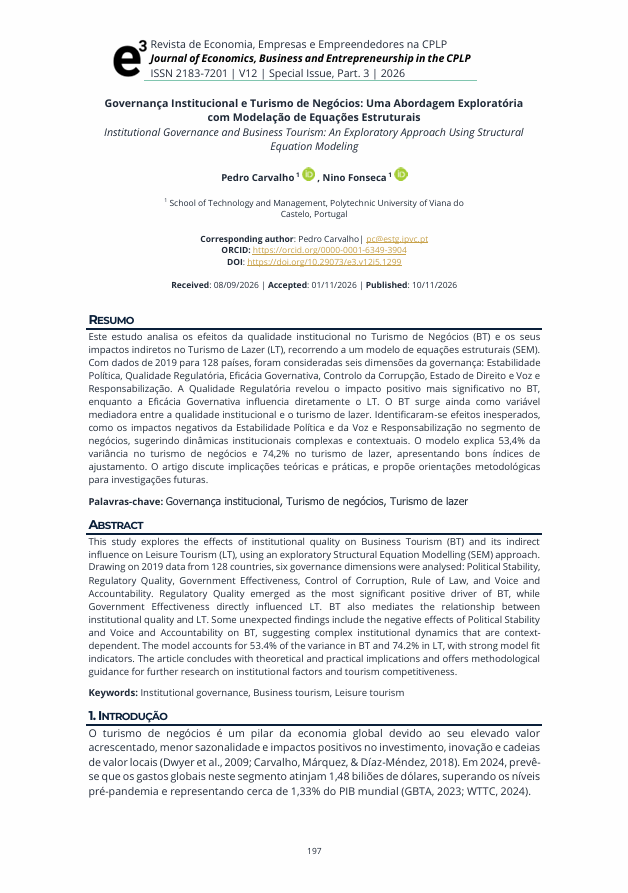
This study explores the effects of institutional quality on Business Tourism (BT) and its indirect influence on Leisure Tourism (LT), using an exploratory Structural Equation Modelling (SEM) approach. Drawing on 2019 data from 128 countries, six governance dimensions were analysed: Political Stability, Regulatory Quality, Government Effectiveness, Control of Corruption, Rule of Law, and Voice and Accountability. Regulatory Quality emerged as the most significant positive driver of BT, while Government Effectiveness directly influenced LT. BT also mediates the relationship between institutional quality and LT. Some unexpected findings include the negative effects of Political Stability and Voice and Accountability on BT, suggesting complex institutional dynamics that are context-dependent. The model accounts for 53.4% of the variance in BT and 74.2% in LT, with strong model fit indicators. The article concludes with theoretical and practical implications and offers methodological guidance for further research on institutional factors and tourism competitiveness.
Downloads
Article Details

This work is licensed under a Creative Commons Attribution 4.0 International License.
All articles published in e3 – Journal of Economics, Business and Entrepreneurship in the community of Portuguese-speaking countries are licensed under the Creative Commons Attribution (CC BY) license.
This license allows users to share (copy and redistribute the material in any medium or format) and adapt (remix, transform, and build upon the material) for any purpose, including commercial use, provided that appropriate credit is given to the original author(s) and the journal, a link to the license is provided, and any changes made are indicated.



References
Abadie, A., & Gardeazabal, J. (2003). The economic costs of conflict: A case study of the Basque Country. American Economic Review, 93(1), 113–132. https://doi.org/10.1257/000282803321455188
Alemán, J., & Woods, D. (2014). Value priorities, institutional constraints, and regime legitimacy in Latin America. Comparative Political Studies, 47(1), 84–112. https://doi.org/10.1177/0010414013488543
Bentum-Ennin, I. (2014). Drivers of international business and holiday tourism in Ghana: A non-parametric approach. International Journal of Economics & Business Studies, 4(1–2), 1–22.
Bradley, A., Hall, T., & Harrison, M. (2002). Selling cities: Promoting new images for meetings tourism. Cities, 19(1), 61–70.
Carvalho, P., Márquez, M. Á., & Díaz-Méndez, M. (2018). Policies to increase business tourism income: A dynamic panel data model. Journal of Convention & Event Tourism, 19, 63–82.
Carvalho, P., Díaz-Méndez, M., & Márquez, M. Á. (2019). What determines the holding of association meetings in a global context? Journal of Travel & Tourism Marketing, 36(9), 969–979. https://doi.org/10.1080/10548408.2019.1657312
Chen, C.-F. (2006). Applying the analytical hierarchy process (AHP) approach to convention site selection. Journal of Travel Research, 45(2), 167–174.
Crouch, G. I., & Ritchie, J. R. B. (1998). Convention site selection research: A review, conceptual model, and propositional framework. Journal of Convention & Exhibition Management, 1(1), 49–69.
Cró, S., & Martins, A. M. (2018). International association meetings: Importance of destination attributes. Journal of Vacation Marketing, 24(3), 218–233.
Davidson, R., & Cope, B. (2003). Business travel: Conferences, incentive travel, exhibitions, corporate hospitality and corporate travel. Pearson Education.
DiPietro, R. B., Breitner, D., Rompf, P., & Godlewska, M. (2008). An exploratory study of differences among meeting and exhibition planners in their destination selection criteria. Journal of Convention & Event Tourism, 9(4), 258–276.
Domareski-Ruiz, V. L., Lopes, L. F. D., Pereira, M. M., & Paiva, T. (2020). Impacts of mega-events on destination competitiveness and corruption perception in South American countries. Tourism & Management Studies, 16(2), 7–15. https://doi.org/10.18089/tms.2020.160201
Dwyer, L., Mellor, R., Mistilis, N., & Mules, T. (2009). Forecasting the economic impacts of events and conventions. Event Management, 11(1–2), 25–38.
Gani, A., & Clemes, M. D. (2021). Business environment effect on business visitor arrivals to New Zealand. Current Issues in Tourism, 24(17), 2445–2457. https://doi.org/10.1080/13683500.2020.1835841
Global Business Travel Association. (2023, August). Global business travel industry spending expected to hit record $1.48 trillion in 2024. https://www.gbta.org/global-business-travel-industry-spending-expected-to-hit-record-1-48-trillion-in-2024/
Gholipour, H. F., & Foroughi, B. (2020). Corruption and outbound business travels. Tourism Economics. https://doi.org/10.1177/1354816620936044
Hall, C. M. (2011). A typology of governance and its implications for tourism policy analysis. Journal of Sustainable Tourism, 19(4–5), 437–457. https://doi.org/10.1080/09669582.2011.570346
Handoyo, S. (2023). Worldwide governance indicators: Cross-country data set 2012–2022. Data in Brief, 51, Article 109814. https://doi.org/10.1016/j.dib.2023.109814
Hankinson, G. (2005). Destination brand images: A business tourism perspective. Journal of Services Marketing, 19(1), 24–32. https://doi.org/10.1108/08876040510579361
Haryanto, R., Anwar, M. M., Harisah, H., & Fadllan, F. (2024). Tourist satisfaction toward halal tourism: The role of tourism governance and branding. Journal of Islamic Marketing, 15(9), 2229–2244. https://doi.org/10.1108/JIMA-09-2023-0282
Kalulu, R., Seun, A. A., & Abel, C. (2022). Rwanda MICE strategy and its influence on the tourism industry: Case study of Rwanda Convention Bureau. African Journal of Tourism and Hospitality Management, 1(1), 15–32. https://doi.org/10.37284/ajthm.1.1.1034
Kaufmann, D., Kraay, A., & Mastruzzi, M. (2010). The Worldwide Governance Indicators: Methodology and analytical issues (Policy Research Working Paper No. 5430). World Bank. https://doi.org/10.1596/1813-9450-5430
Kerr, G., Cliff, K., & Dolnicar, S. (2012). Harvesting the “business test trip”: Converting business travelers to holidaymakers. Journal of Travel & Tourism Marketing, 29(5), 405–415. https://doi.org/10.1080/10548408.2012.691390
Khan, R. E. A., Ahmad, T., & Haleem, J. (2021). The governance and tourism: A case of developing countries. Asian Journal of Economic Modelling, 9(1), 33–42.
Kline, R. B. (2016). Principles and practice of structural equation modeling (4th ed.). Guilford Press.
Kulendran, N., & Witt, S. (2003). Forecasting the demand for international business tourism. Journal of Travel Research, 41(3), 265–271.
Ladkin, A. (2006). Conference tourism—MICE market and business tourism. In D. Buhalis & C. Costa (Eds.), Tourism management dynamics: Trends, management and tools (pp. 183–189). Elsevier.
Makoni, L., & Rogerson, C. M. (2023). Business tourism in an African city: Evidence from Harare, Zimbabwe. Studia Periegetica, 43(3), 25–48. https://doi.org/10.58683/sp.596
Marchesani, F., & Masciarelli, F. (2025). The nexus of MICE tourism in smart cities: Understanding its effects and complexities with urban mobility and crime. Current Issues in Tourism, 1–20. https://doi.org/10.1080/13683500.2025.2458120
Marques, R., Alves, C., & Wada, E. K. (2019). Impacts of corruption on tourism. In The Routledge handbook of tourism impacts. Routledge.
Mastrandrea, G., Gil, H., & De Simon, A. (2023). Smart governance for MICE tourism development: A European comparative study. Sustainability, 15(3), Article 11345. https://doi.org/10.3390/su150311345
Min, C. K., Roh, T. S., & Bak, S. (2016). Growth effects of leisure tourism and the level of economic development. Applied Economics, 48(1), 7–17. https://doi.org/10.1080/00036846.2015.1073838
Moll-de-Alba, J., Prats, L., & Coromina, L. (2016). The need to adapt to travel expenditure patterns: A study comparing business and leisure tourists in Barcelona. Eurasian Business Review, 6(2), 253–267. https://doi.org/10.1007/s40821-016-0046-4
Ormond, M., & Mainil, T. (2015). Government and governance strategies in medical tourism. In N. Lunt, D. Horsfall, & J. Hanefeld (Eds.), Handbook on medical tourism and patient mobility (pp. 154–163). Edward Elgar Publishing.
Park, J., Wu, B., Shen, Y., Morrison, A. M., & Kong, Y. (2014). The Great Halls of China? Meeting planners' perceptions of Beijing as an international convention destination. Journal of Convention & Event Tourism, 15(4), 244–270. https://doi.org/10.1080/15470148.2014.961669
Pinho, M., & Marques, J. (2021). The bleisure tourism trend and the potential for this business–leisure symbiosis in Porto. Journal of Convention & Event Tourism, 22(4), 346–362. https://doi.org/10.1080/15470148.2021.1905575
Pryde, A. (2017). How marketing built Dubai. Cambridge Marketing Review, 13, 39–43.
Raza, S. A., Ahmed, M., & Irfan, M. (2024). The relationship between governance structure and tourism development in China: Evidence from time and frequency domains. International Social Science Journal. https://doi.org/10.1111/issj.12512
Santos, G. E. de O., Gursoy, D., Ribeiro, M. A., & Panosso Netto, A. (2019). Impact of transparency and corruption on mega-event support. Event Management, 23(1), 27–40. https://doi.org/10.3727/152599518X15378845225311
Schumacker, R. E., & Lomax, R. G. (2016). A beginner's guide to structural equation modeling (4th ed.). Routledge.
Singh, V. (2023). Impact of crime on our tourism industry: With special effect to legal safeguard. Educational Administration: Theory and Practice, 29(4), 4121–4128.
Suwannasat, J., Katawandee, P., Chandrachai, A., & Bhattarakosol, P. (2022). Site selection determinant factors: An empirical study from meeting and conference organizers’ perspectives. Journal of Convention & Event Tourism, 23(3), 209–239. https://doi.org/10.1080/15470148.2022.2034557
Tichaawa, T. M. (2021). Informal business tourism in Cameroon. GeoJournal of Tourism and Geosites, 38(4), 1289–1298. https://doi.org/10.30892/gtg.38437-771
Tretyakevich, N., & Maggi, R. (2012). Not just for business: Some evidence on leisure motivations of conference attendees. Current Issues in Tourism, 15(4), 391–395. https://doi.org/10.1080/13683500.2011.586077
Williamson, O. E. (2000). The new institutional economics: Taking stock, looking ahead. Journal of Economic Literature, 38(3), 595–613.
World Travel & Tourism Council. (2024, April). Travel & tourism set to contribute record $11.1 trillion to global economy in 2024. https://wttc.org/news-article/travel-tourism-set-to-contribute-record-11-1-trillion-to-global-economy-in-2024
Xu, C., Yang, Y., Dossou, T. A. M., Berhe, M. W., & Kambaye, E. N. (2023). Does corruption undermine tourism development in Africa? Current Issues in Tourism, 26(11), 1779–1796. https://doi.org/10.1080/13683500.2022.2069553