GOVERNANÇA INSTITUCIONAL E TURISMO DE NEGÓCIOS: UMA ABORDAGEM EXPLORATÓRIA COM MODELAÇÃO DE EQUAÇÕES ESTRUTURAIS
Barra lateral del artículo
Contenido principal del artículo
Resumen
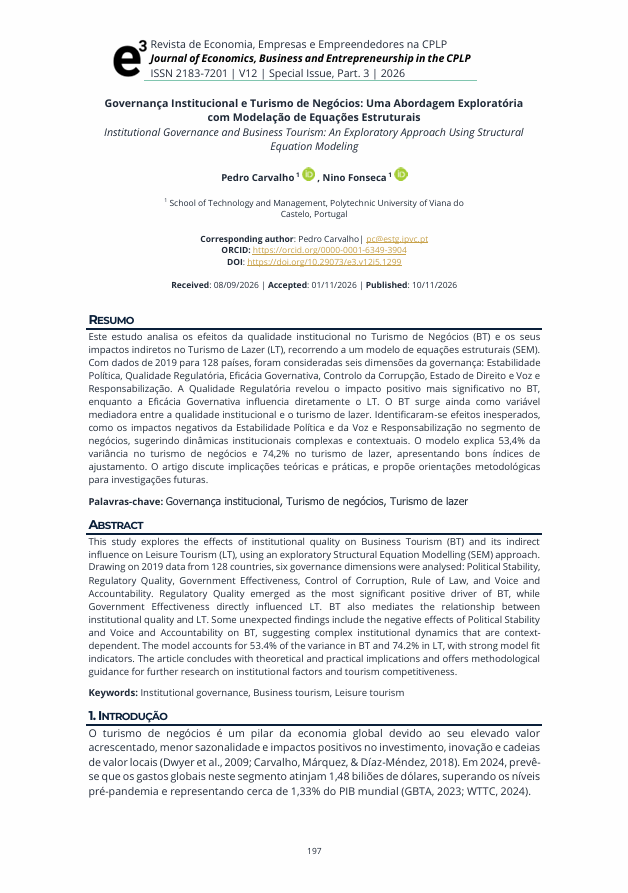
Este estudo analisa os efeitos da qualidade institucional no Turismo de Negócios (BT) e os seus impactos indiretos no Turismo de Lazer (LT), recorrendo a um modelo de equações estruturais (SEM). Com dados de 2019 para 128 países, foram consideradas seis dimensões da governança: Estabilidade Política, Qualidade Regulatória, Eficácia Governativa, Controlo da Corrupção, Estado de Direito e Voz e Responsabilização. A Qualidade Regulatória revelou o impacto positivo mais significativo no BT, enquanto a Eficácia Governativa influencia diretamente o LT. O BT surge ainda como variável mediadora entre a qualidade institucional e o turismo de lazer. Identificaram-se efeitos inesperados, como os impactos negativos da Estabilidade Política e da Voz e Responsabilização no segmento de negócios, sugerindo dinâmicas institucionais complexas e contextuais. O modelo explica 53,4% da variância no turismo de negócios e 74,2% no turismo de lazer, apresentando bons índices de ajustamento. O artigo discute implicações teóricas e práticas, e propõe orientações metodológicas para investigações futuras.
Descargas
Detalles del artículo

Esta obra está bajo una licencia internacional Creative Commons Atribución 4.0.
Todos los artículos publicados en la e3 – Revista de Economía, Empresas y Emprendimiento en la CPLP se distribuyen bajo la licencia Creative Commons Atribución (CC BY).
Esta licencia permite compartir (copiar y redistribuir el material en cualquier medio o formato) y adaptar (remezclar, transformar y crear a partir del material) para cualquier propósito, incluso comercial, siempre que se otorgue el crédito adecuado a los autores y a la revista, se proporcione un enlace a la licencia y se indiquen los cambios realizados.



Citas
Abadie, A., & Gardeazabal, J. (2003). The economic costs of conflict: A case study of the Basque Country. American Economic Review, 93(1), 113–132. https://doi.org/10.1257/000282803321455188
Alemán, J., & Woods, D. (2014). Value priorities, institutional constraints, and regime legitimacy in Latin America. Comparative Political Studies, 47(1), 84–112. https://doi.org/10.1177/0010414013488543
Bentum-Ennin, I. (2014). Drivers of international business and holiday tourism in Ghana: A non-parametric approach. International Journal of Economics & Business Studies, 4(1–2), 1–22.
Bradley, A., Hall, T., & Harrison, M. (2002). Selling cities: Promoting new images for meetings tourism. Cities, 19(1), 61–70.
Carvalho, P., Márquez, M. Á., & Díaz-Méndez, M. (2018). Policies to increase business tourism income: A dynamic panel data model. Journal of Convention & Event Tourism, 19, 63–82.
Carvalho, P., Díaz-Méndez, M., & Márquez, M. Á. (2019). What determines the holding of association meetings in a global context? Journal of Travel & Tourism Marketing, 36(9), 969–979. https://doi.org/10.1080/10548408.2019.1657312
Chen, C.-F. (2006). Applying the analytical hierarchy process (AHP) approach to convention site selection. Journal of Travel Research, 45(2), 167–174.
Crouch, G. I., & Ritchie, J. R. B. (1998). Convention site selection research: A review, conceptual model, and propositional framework. Journal of Convention & Exhibition Management, 1(1), 49–69.
Cró, S., & Martins, A. M. (2018). International association meetings: Importance of destination attributes. Journal of Vacation Marketing, 24(3), 218–233.
Davidson, R., & Cope, B. (2003). Business travel: Conferences, incentive travel, exhibitions, corporate hospitality and corporate travel. Pearson Education.
DiPietro, R. B., Breitner, D., Rompf, P., & Godlewska, M. (2008). An exploratory study of differences among meeting and exhibition planners in their destination selection criteria. Journal of Convention & Event Tourism, 9(4), 258–276.
Domareski-Ruiz, V. L., Lopes, L. F. D., Pereira, M. M., & Paiva, T. (2020). Impacts of mega-events on destination competitiveness and corruption perception in South American countries. Tourism & Management Studies, 16(2), 7–15. https://doi.org/10.18089/tms.2020.160201
Dwyer, L., Mellor, R., Mistilis, N., & Mules, T. (2009). Forecasting the economic impacts of events and conventions. Event Management, 11(1–2), 25–38.
Gani, A., & Clemes, M. D. (2021). Business environment effect on business visitor arrivals to New Zealand. Current Issues in Tourism, 24(17), 2445–2457. https://doi.org/10.1080/13683500.2020.1835841
Global Business Travel Association. (2023, August). Global business travel industry spending expected to hit record $1.48 trillion in 2024. https://www.gbta.org/global-business-travel-industry-spending-expected-to-hit-record-1-48-trillion-in-2024/
Gholipour, H. F., & Foroughi, B. (2020). Corruption and outbound business travels. Tourism Economics. https://doi.org/10.1177/1354816620936044
Hall, C. M. (2011). A typology of governance and its implications for tourism policy analysis. Journal of Sustainable Tourism, 19(4–5), 437–457. https://doi.org/10.1080/09669582.2011.570346
Handoyo, S. (2023). Worldwide governance indicators: Cross-country data set 2012–2022. Data in Brief, 51, Article 109814. https://doi.org/10.1016/j.dib.2023.109814
Hankinson, G. (2005). Destination brand images: A business tourism perspective. Journal of Services Marketing, 19(1), 24–32. https://doi.org/10.1108/08876040510579361
Haryanto, R., Anwar, M. M., Harisah, H., & Fadllan, F. (2024). Tourist satisfaction toward halal tourism: The role of tourism governance and branding. Journal of Islamic Marketing, 15(9), 2229–2244. https://doi.org/10.1108/JIMA-09-2023-0282
Kalulu, R., Seun, A. A., & Abel, C. (2022). Rwanda MICE strategy and its influence on the tourism industry: Case study of Rwanda Convention Bureau. African Journal of Tourism and Hospitality Management, 1(1), 15–32. https://doi.org/10.37284/ajthm.1.1.1034
Kaufmann, D., Kraay, A., & Mastruzzi, M. (2010). The Worldwide Governance Indicators: Methodology and analytical issues (Policy Research Working Paper No. 5430). World Bank. https://doi.org/10.1596/1813-9450-5430
Kerr, G., Cliff, K., & Dolnicar, S. (2012). Harvesting the “business test trip”: Converting business travelers to holidaymakers. Journal of Travel & Tourism Marketing, 29(5), 405–415. https://doi.org/10.1080/10548408.2012.691390
Khan, R. E. A., Ahmad, T., & Haleem, J. (2021). The governance and tourism: A case of developing countries. Asian Journal of Economic Modelling, 9(1), 33–42.
Kline, R. B. (2016). Principles and practice of structural equation modeling (4th ed.). Guilford Press.
Kulendran, N., & Witt, S. (2003). Forecasting the demand for international business tourism. Journal of Travel Research, 41(3), 265–271.
Ladkin, A. (2006). Conference tourism—MICE market and business tourism. In D. Buhalis & C. Costa (Eds.), Tourism management dynamics: Trends, management and tools (pp. 183–189). Elsevier.
Makoni, L., & Rogerson, C. M. (2023). Business tourism in an African city: Evidence from Harare, Zimbabwe. Studia Periegetica, 43(3), 25–48. https://doi.org/10.58683/sp.596
Marchesani, F., & Masciarelli, F. (2025). The nexus of MICE tourism in smart cities: Understanding its effects and complexities with urban mobility and crime. Current Issues in Tourism, 1–20. https://doi.org/10.1080/13683500.2025.2458120
Marques, R., Alves, C., & Wada, E. K. (2019). Impacts of corruption on tourism. In The Routledge handbook of tourism impacts. Routledge.
Mastrandrea, G., Gil, H., & De Simon, A. (2023). Smart governance for MICE tourism development: A European comparative study. Sustainability, 15(3), Article 11345. https://doi.org/10.3390/su150311345
Min, C. K., Roh, T. S., & Bak, S. (2016). Growth effects of leisure tourism and the level of economic development. Applied Economics, 48(1), 7–17. https://doi.org/10.1080/00036846.2015.1073838
Moll-de-Alba, J., Prats, L., & Coromina, L. (2016). The need to adapt to travel expenditure patterns: A study comparing business and leisure tourists in Barcelona. Eurasian Business Review, 6(2), 253–267. https://doi.org/10.1007/s40821-016-0046-4
Ormond, M., & Mainil, T. (2015). Government and governance strategies in medical tourism. In N. Lunt, D. Horsfall, & J. Hanefeld (Eds.), Handbook on medical tourism and patient mobility (pp. 154–163). Edward Elgar Publishing.
Park, J., Wu, B., Shen, Y., Morrison, A. M., & Kong, Y. (2014). The Great Halls of China? Meeting planners' perceptions of Beijing as an international convention destination. Journal of Convention & Event Tourism, 15(4), 244–270. https://doi.org/10.1080/15470148.2014.961669
Pinho, M., & Marques, J. (2021). The bleisure tourism trend and the potential for this business–leisure symbiosis in Porto. Journal of Convention & Event Tourism, 22(4), 346–362. https://doi.org/10.1080/15470148.2021.1905575
Pryde, A. (2017). How marketing built Dubai. Cambridge Marketing Review, 13, 39–43.
Raza, S. A., Ahmed, M., & Irfan, M. (2024). The relationship between governance structure and tourism development in China: Evidence from time and frequency domains. International Social Science Journal. https://doi.org/10.1111/issj.12512
Santos, G. E. de O., Gursoy, D., Ribeiro, M. A., & Panosso Netto, A. (2019). Impact of transparency and corruption on mega-event support. Event Management, 23(1), 27–40. https://doi.org/10.3727/152599518X15378845225311
Schumacker, R. E., & Lomax, R. G. (2016). A beginner's guide to structural equation modeling (4th ed.). Routledge.
Singh, V. (2023). Impact of crime on our tourism industry: With special effect to legal safeguard. Educational Administration: Theory and Practice, 29(4), 4121–4128.
Suwannasat, J., Katawandee, P., Chandrachai, A., & Bhattarakosol, P. (2022). Site selection determinant factors: An empirical study from meeting and conference organizers’ perspectives. Journal of Convention & Event Tourism, 23(3), 209–239. https://doi.org/10.1080/15470148.2022.2034557
Tichaawa, T. M. (2021). Informal business tourism in Cameroon. GeoJournal of Tourism and Geosites, 38(4), 1289–1298. https://doi.org/10.30892/gtg.38437-771
Tretyakevich, N., & Maggi, R. (2012). Not just for business: Some evidence on leisure motivations of conference attendees. Current Issues in Tourism, 15(4), 391–395. https://doi.org/10.1080/13683500.2011.586077
Williamson, O. E. (2000). The new institutional economics: Taking stock, looking ahead. Journal of Economic Literature, 38(3), 595–613.
World Travel & Tourism Council. (2024, April). Travel & tourism set to contribute record $11.1 trillion to global economy in 2024. https://wttc.org/news-article/travel-tourism-set-to-contribute-record-11-1-trillion-to-global-economy-in-2024
Xu, C., Yang, Y., Dossou, T. A. M., Berhe, M. W., & Kambaye, E. N. (2023). Does corruption undermine tourism development in Africa? Current Issues in Tourism, 26(11), 1779–1796. https://doi.org/10.1080/13683500.2022.2069553