GEOEDUCATION AND VALORISATION OF ECOCULTURAL RESOURCES: CONTRIBUTIONS TO TOURISM SUSTAINABILITY AT ESTRELA GEOPARK (PORTUGAL)
Barra lateral del artículo
Contenido principal del artículo
Resumen
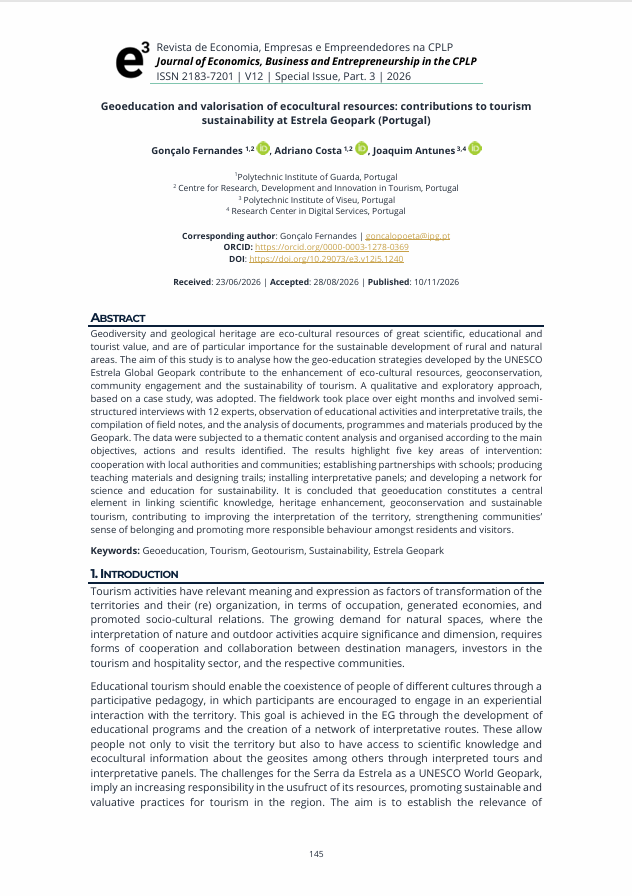
Geodiversity and geological heritage are eco-cultural resources of great scientific, educational and tourist value, and are of particular importance for the sustainable development of rural and natural areas. The aim of this study is to analyse how the geo-education strategies developed by the UNESCO Estrela Global Geopark contribute to the enhancement of eco-cultural resources, geoconservation, community engagement and the sustainability of tourism. A qualitative and exploratory approach, based on a case study, was adopted. The fieldwork took place over eight months and involved semi-structured interviews with 12 experts, observation of educational activities and interpretative trails, the compilation of field notes, and the analysis of documents, programmes and materials produced by the Geopark. The data were subjected to a thematic content analysis and organised according to the main objectives, actions and results identified. The results highlight five key areas of intervention: cooperation with local authorities and communities; establishing partnerships with schools; producing teaching materials and designing trails; installing interpretative panels; and developing a network for science and education for sustainability. It is concluded that geoeducation constitutes a central element in linking scientific knowledge, heritage enhancement, geoconservation and sustainable tourism, contributing to improving the interpretation of the territory, strengthening communities’ sense of belonging and promoting more responsible behaviour amongst residents and visitors.
Descargas
Detalles del artículo

Esta obra está bajo una licencia internacional Creative Commons Atribución 4.0.
Todos los artículos publicados en la e3 – Revista de Economía, Empresas y Emprendimiento en la CPLP se distribuyen bajo la licencia Creative Commons Atribución (CC BY).
Esta licencia permite compartir (copiar y redistribuir el material en cualquier medio o formato) y adaptar (remezclar, transformar y crear a partir del material) para cualquier propósito, incluso comercial, siempre que se otorgue el crédito adecuado a los autores y a la revista, se proporcione un enlace a la licencia y se indiquen los cambios realizados.



Citas
Berman, M., Jonides, J., & Kaplan, S. (2008). The cognitive benefits of interacting with nature. Psychological Science, 19(12), 1207–1212.
Brilha, J. B. R. (2005). Património geológico e geoconservação: A conservação da natureza na sua vertente geológica. Universidade do Minho.
Burek, C. V., & Prosser, C. D. (2008). The history of geoconservation: An introduction. Geological Society, London, Special Publications, 300, 1–5. https://doi.org/10.1144/SP300.1
Catana, A., & Alves, R. (2008). Geoparques e geoturismo: Conceitos para um desenvolvimento sustentável. 46.º Congresso Brasileiro de Geologia.
Čtveráková, I., Fialová, D., Kučera, Z., & Chromý, P. (2016). Barriers in the functioning of Czech geoparks in the context of different circumstances. AUC Geographica, 51(2), 235–246. https://doi.org/10.14712/23361980.2016.19
Dowling, R. K. (2015). Geotourism’s contribution to sustainable tourism. In M. Hughes, D. Weaver, & C. Pforr (Eds.), The practice of sustainable tourism: Resolving the paradox (pp. 207–227). Routledge.
Eder, W., & Patzak, M. (2004). Geoparks – geological attractions: A tool for public education, recreation, and sustainable economic development. Episodes, 27(3), 162–164.
Farsani, N. T., Coelho, C., & Costa, C. (2012). Geotourism and geoparks as gateways to socio-cultural sustainability in Qeshm rural areas, Iran. Asia Pacific Journal of Tourism Research, 17, 30–48.
Fernandes, G. P., Castro, E., & Tracana, R. B. (2020). Tourism as a strategy for geoeducation and cultural valorization of territories: Promoting eco-cultural values and geoconservation in Estrela Geopark, Portugal. In F. Brandão, Z. Breda, R. Costa, & C. Costa (Eds.), Handbook of research on the role of tourism in achieving sustainable development goals (pp. 117–137). https://doi.org/10.4018/978-1-7998-5691-7.ch007
Fernandes, G., Castro, E., Firmino, G., & Ferreira, A. (2016). Geoparks and regional and local development: Aspiring Estrela Geopark [Conference abstract]. European Geoparks Conference. https://doi.org/10.13140/RG.2.2.28770.94405
Fernandes, G., Tracana, R., Castro, E., & Fernandes, M. (2021). Geoeducation and tourism in Estrela UNESCO Global Geopark (Portugal) and its contributions to the construction of a sustainable destination. In A. Mandić & L. Petrić (Eds.), Mediterranean protected areas in the era of overtourism (pp. 137–152). Springer.
Frey, M. L., Schäfer, K., Büchel, G., & Patzak, M. (2016). Geoparks: A regional European and global policy. In Geotourism. https://doi.org/10.1016/B978-0-7506-6215-4.50014-2
Gomes, H., Fernandes, M., Castro, E., & Vieira, G. (2017). The (Serra da) Estrela Aspiring Geopark (Portugal): Preserving geoheritage, while promoting science and its links to local communities. Geophysical Research Abstracts, 19 [Conference abstract]. EGU General Assembly.
Górska-Zabielska, M. (2023). New geoeducational facilities in Central Mazovia (Poland) disseminate knowledge about local geoheritage. Sustainability, 15(22), Article 16115. https://doi.org/10.3390/su152216115
Henriques, M. H., Reis, R., Brilha, J., & Mota, T. (2011). Geoconservation as an emerging geoscience. Geoheritage, 3, 117–128. https://doi.org/10.1007/s12371-011-0039-8
Hose, T.A., Vasiljević, D.A. Defining the Nature and Purpose of Modern Geotourism with Particular Reference to the United Kingdom and South-East Europe. Geoheritage 4, 25–43 (2012). https://doi.org/10.1007/s12371-011-0050-0
Hose, T. (2005). Geoturismo europeo: Interpretación geológica y promoción de la conservación geológica para turistas. In D. Barretino, W. A. P. Wimbledon, & E. Gallego (Eds.), Patrimonio geológico: Conservación y gestión. Instituto Tecnológico Geominero de España.
Kusumah, E. P., Wahyudin, N., Purbalakseto, H. V., & Utami, E. (2023). Case studies of the Belitong Geopark as a UNESCO Global Geopark: Evaluating geosites for geotourism development. E3S Web of Conferences, 448, Article 03025. [EDP Sciences.]
Meléndez, G., Fermeli, G., Moreira, J., Escorihuela, J., & Basso, A. (2011). What do we mean when we say geotourism? In Proceedings of the 1st International Congress: Geotourism in Action (pp. 97–100). Geopark Arouca.
Miśkiewicz, K. (2016). Promoting geoheritage in geoparks as an element of educational tourism. In A. Szponar & S. Toczek-Werner (Eds.), Geotourism: Organization of the tourism and education in the geoparks in the Middle-Europe Mountains. University of Business.
Mokhtari, D., Roostaei, S., Khodadadi, M., Ahmadi, M., Ebrahimi, O., & Shahabi, H. (2019). Evaluation of the role of environmental education in Manesht and Ghelarang Geotourism Destination, Iran. Journal of Quality Assurance in Hospitality & Tourism. https://doi.org/10.1080/1528008X.2019.1616039
Novaes, V., & Pena, L. (2016). Reflections on the development of Geopark projects from the territory and tourism perspectives. Cenário, 6, 139–155.
UNESCO. (2015). Statutes of the International Geoscience and Geoparks Programme and operational guidelines for UNESCO Global Geoparks.
UNESCO. (2023a). About UNESCO Global Geoparks. https://www.unesco.org/en/iggp/geoparks/about
UNESCO. (2023b). Operational guidelines for UNESCO Global Geoparks.
Zouros, N. (2004). The European Geoparks Network: Geological heritage protection and local development. Episodes, 27(3), 165–171. https://doi.org/10.18814/epiiugs/2004/v27i3/002