
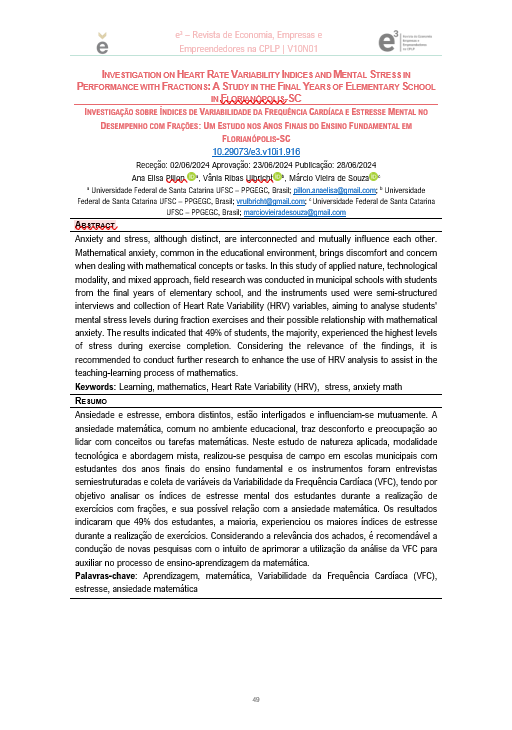
INVESTIGATION ON HEART RATE VARIABILITY INDICES AND MENTAL STRESS IN PERFORMANCE WITH FRACTIONS: A STUDY IN THE FINAL YEARS OF ELEMENTARY SCHOOL IN FLORIANÓPOLIS-SC
Barra lateral del artículo
Contenido principal del artículo
Resumen
La ansiedad y el estrés, aunque distintos, están interconectados y se influyen mutuamente. La ansiedad matemática, común en el entorno educativo, trae malestar y preocupación al abordar conceptos o tareas matemáticas. En este estudio de carácter aplicado, modalidad tecnológica y enfoque mixto, se realizó una investigación de campo en escuelas municipales con estudiantes de los últimos años de la educación básica y los instrumentos fueron entrevistas semiestructuradas y recolección de variables de Variabilidad de la Frecuencia Cardíaca (VFC), con el objetivo de El objetivo es analizar los niveles de estrés mental de los estudiantes al realizar ejercicios con fracciones, y su posible relación con la ansiedad matemática. Los resultados indicaron que el 49% de los estudiantes, la mayoría, experimentaron los niveles más altos de estrés mientras realizaban ejercicios. Considerando la relevancia de los hallazgos, se recomienda realizar nuevas investigaciones con el objetivo de mejorar el uso del análisis HRV para ayudar en el proceso de enseñanza-aprendizaje de las matemáticas.
Descargas
Detalles del artículo

Esta obra está bajo una licencia internacional Creative Commons Atribución 4.0.
Todos los artículos publicados en la e3 – Revista de Economía, Empresas y Emprendimiento en la CPLP se distribuyen bajo la licencia Creative Commons Atribución (CC BY).
Esta licencia permite compartir (copiar y redistribuir el material en cualquier medio o formato) y adaptar (remezclar, transformar y crear a partir del material) para cualquier propósito, incluso comercial, siempre que se otorgue el crédito adecuado a los autores y a la revista, se proporcione un enlace a la licencia y se indiquen los cambios realizados.



Citas
Brazil. Ministry of Education. (2018). National Common Curricular Base (BNCC).
Carmo, J. D. S., & Simionato, A. M. (2012). Reversing math anxiety: Some data from the literature. Psicologia em Estudo, 17, 317-327.
Colomeischi, A. A., & Colomeischi, T. (2015). The students' emotional life and their attitude toward mathematics learning. Procedia - Social and Behavioral Sciences, 180, 744-750. https://www.researchgate.net/publication/277948001.
Creswell, J. W. (2010). Research design: Qualitative, quantitative, and mixed methods approaches (3rd ed.). Porto Alegre: Artmed. (pp. 206-237).
Fonseca, S. S. da, & Santos, R. dos. (2019). Difficulties of 7th grade students in learning fractions. Revista Insignare Scientia-RIS, 2(1), 50-66.
Galvão Filho, I. (2022). Fractus: Application for learning fractions (Master's thesis). Graduate Program in Engineering and Knowledge Management, Federal University of Santa Catarina UFSC, Florianópolis. https://repositorio.ufsc.br/handle/123456789/236297.
Heart Math. (2024). Inner Balance™: An unparalleled window into your emotional wellbeing. https://www.heartmath.com/The-Inner-Balance/.
Herreras, E. B. (2018). PISA 2012: Anxiety and low performance in mathematical competence. Revista Iberoamericana de Diagnóstico y Evaluación-e Avaliação Psicológica, 1(46), 161-173. https://doi.org/10.21865/RIDEP46.1.12.
Hilgarter, K., Schmid-Zalaudek, K., Csanády-Leitner, R., Mörtl, M., Rössler, A., & Lackner, H. K. (2021). Phasic heart rate variability and the association with cognitive performance: A cross-sectional study in a healthy population setting. PLoS One, 16(3), e0246968. https://doi.org/10.1371/journal.pone.0246968.
Lopes, L. F. D. (2018). Quantitative methods applied to organizational behavior. Santa Maria-RS: Editora Voix.
Loureiro, J. P. (2018). Physiological responses of healthy men to variations in the difficulty level of a puzzle video game (Master's thesis). Graduate Program in Biomedical Engineering, Coppe, Federal University of Rio de Janeiro, Rio de Janeiro.
Loures, D. L., Sant'Anna, I., Baldotto, C. S. D. R., Sousa, E. B. D., & Nóbrega, A. C. L. D. (2002). Mental stress and the cardiovascular system. Arquivos Brasileiros de Cardiologia, 78, 525-530.
Madison, A., Vasey, M., Emery, C. F., & Kiecolt-Glaser, J. K. (2021). Social anxiety symptoms, heart rate variability, and vocal emotion recognition in women: Evidence for parasympathetically-mediated positivity bias. Anxiety, Stress & Coping, 34(3), 243-257. https://doi.org/10.1080/10615806.2020.1839733.
Margis, R., Picon, P., Cosner, A. F., & Silveira, R. D. O. (2003). Relationship between stressors, stress, and anxiety. Revista de Psiquiatria do Rio Grande do Sul, 25(suppl 1), 65-74. https://doi.org/10.1590/s0101-81082003000400008.
Matos, J. B. (2013). Effect of heart rate variability on cognitive attention after the T-Car exercise test in tennis players (Master's thesis). Psychology Course, Federal University of Santa Catarina, Florianópolis, SC.
Moura-Silva, M. G., Torres Neto, J. B., & Gonçalves, T. O. (2020). Neural bases of math anxiety: Implications for the teaching-learning process. Bolema: Boletim de Educação Matemática, 34(66), 246-267. https://doi.org/10.1590/1980-4415v34n66a12.
Oliveira, E. A. de C., & Oliveira, M. de F. A. de. (2017). Difficulties presented by elementary school students in the subject of mathematics. Revista Práxis, 3(5), 35-43. http://dx.doi.org/10.25119/praxis-3-5-973.
Omar, S. H., Aris, S. R. S., & Hoon, T. S. (2022). Mathematics anxiety and its relationship with mathematics achievement among secondary school students. Asian Journal of University Education, 18(4), 863-878.
Pillon, A. E., Ulbricht, V. R., Souza, M. V. de, & Fontenele, A. F. G. T. (2023). Heart rate variability analysis to track stress level while learning mathematics. In 2023 18th Iberian Conference on Information Systems and Technologies (CISTI) (pp. 1-6). IEEE.
Pillon, A. E., Ulbricht, V. R., Nascimento, P. C. do, Paula, G. L. de S., & Souza, M. V. de. (2024). Exploring mathematics learning: An investigation of heart rate variability in the context of fraction activities in elementary school. Cuadernos de Educación y Desarrollo, 16(3), e3606-e3606.
Pizzie, R. G., McDermott, C. L., Salem, T. G., & Kraemer, D. J. M. (2020). Neural evidence for cognitive reappraisal as a strategy to alleviate the effects of math anxiety. Social Cognitive and Affective Neuroscience, 15(12), 1271-1287. https://doi.org/10.1093/scan/nsaa161.
Sbissa, P. P. M. (2014). Effect of controlled breathing and mindfulness meditation on heart rate variability (Doctoral dissertation). Psychology Course, Graduate Program in Psychology, Federal University of Santa Catarina, Florianópolis, SC.
Segarra, J., & Julià, C. (2021). Attitude towards mathematics of fifth grade primary school students and teachers' self-efficacy. Ciencias Psicológicas, 15(1), 1-14. http://www.scielo.edu.uy/scielo.php?script=sci_arttext&pid=S1688-42212021000101216&lng=es&nrm=iso.
Sgobbi, F. S., Tarouco, L. M. R., & Herpich, F. (2019). The use of a heart rate monitor to infer cognitive clues in adult students. Renote, 17(1), 134-143. Federal University of Rio Grande do Sul. http://dx.doi.org/10.22456/1679-1916.95715.
Silva, F. O. da. (2017). Use of mobile devices and augmented reality resources in mathematics classes (Master's thesis). Professional Master's Program in Mathematics, School of Sciences and Technology, São Paulo State University Júlio de Mesquita Filho, Presidente Prudente – SP. https://repositorio.unesp.br/bitstream/handle/11449/151423/silva_f_me_prud.pdf?sequence=3&isAllowed=y.
Silveira, D. T., & Cordova, F. P. (2009). Scientific research. In T. E. Gerharddt & D. T. Silveira (Eds.), Research Methods (pp. 31-42). Porto Alegre: Publisher of UFRGS.
Tarvainen, M., Lipponen, J., Niskanen, J., & Ranta-aho, P. O. (Version 3.5). Kubios HRV Software: User's guide. Kubios HRV Standard. Kubios HRV Premium. https://www.kubios.com.
Thayer, J. F. (2007). What the heart says to the brain (and vice versa) and why we should listen. Psychological Topics, 16(2), 241–250.
Thayer, J. F., Lane, R. D., & Bernard, C. (2009). The heart-brain connection: Further elaboration of a model of neurovisceral integration. Neuroscience & Biobehavioral Reviews, 33(2), 81-88.
Vanderlei, L. C. M., Pastre, C. M., Hoshi, R. A., Carvalho, T. D. D., & Godoy, M. F. D. (2009). Basic notions of heart rate variability and its clinical applicability. Brazilian Journal of Cardiovascular Surgery, 24(2), 205–217. https://doi.org/10.1590/s0102-76382009000200018.