
INVESTIGAÇÃO SOBRE ÍNDICES DE VARIABILIDADE DA FREQUÊNCIA CARDÍACA E ESTRESSE MENTAL NO DESEMPENHO COM FRAÇÕES: UM ESTUDO NOS ANOS FINAIS DO ENSINO FUNDAMENTAL EM FLORIANÓPOLIS-SC
Article Sidebar
Main Article Content
Resumo
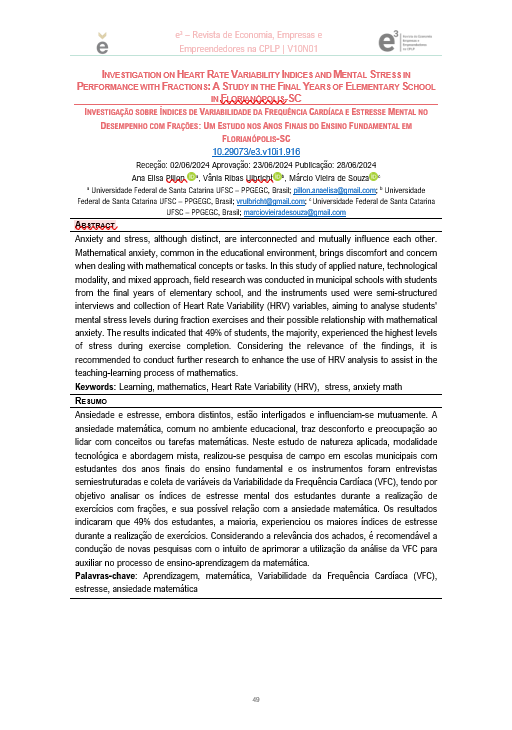
Ansiedade e estresse, embora distintos, estão interligados e influenciam-se mutuamente. A ansiedade matemática, comum no ambiente educacional, traz desconforto e preocupação ao lidar com conceitos ou tarefas matemáticas. Neste estudo de natureza aplicada, modalidade tecnológica e abordagem mista, realizou-se pesquisa de campo em escolas municipais com estudantes dos anos finais do ensino fundamental e os instrumentos foram entrevistas semiestruturadas e coleta de variáveis da Variabilidade da Frequência Cardíaca (VFC), tendo por objetivo analisar os índices de estresse mental dos estudantes durante a realização de exercícios com frações, e sua possível relação com a ansiedade matemática. Os resultados indicaram que 49% dos estudantes, a maioria, experenciou os maiores índices de estresse durante a realização de exercícios. Considerando a relevância dos achados, é recomendável a condução de novas pesquisas com o intuito de aprimorar a utilização da análise da VFC para auxiliar no processo de ensino-aprendizagem da matemática.
Downloads
Article Details

Este trabalho encontra-se publicado com a Licença Internacional Creative Commons Atribuição 4.0.
Todos os artigos publicados na e3 – Revista de Economia, Empresas e Empreendedorismo na CPLP são disponibilizados sob a licença Creative Commons Atribuição (CC BY).
Esta licença permite partilhar (copiar e redistribuir o material em qualquer suporte ou formato) e adaptar (remisturar, transformar e criar a partir do material) para qualquer finalidade, incluindo fins comerciais, desde que seja atribuída a devida autoria aos autores e à revista, seja fornecida ligação para a licença e sejam indicadas eventuais alterações.



Referências
Brazil. Ministry of Education. (2018). National Common Curricular Base (BNCC).
Carmo, J. D. S., & Simionato, A. M. (2012). Reversing math anxiety: Some data from the literature. Psicologia em Estudo, 17, 317-327.
Colomeischi, A. A., & Colomeischi, T. (2015). The students' emotional life and their attitude toward mathematics learning. Procedia - Social and Behavioral Sciences, 180, 744-750. https://www.researchgate.net/publication/277948001.
Creswell, J. W. (2010). Research design: Qualitative, quantitative, and mixed methods approaches (3rd ed.). Porto Alegre: Artmed. (pp. 206-237).
Fonseca, S. S. da, & Santos, R. dos. (2019). Difficulties of 7th grade students in learning fractions. Revista Insignare Scientia-RIS, 2(1), 50-66.
Galvão Filho, I. (2022). Fractus: Application for learning fractions (Master's thesis). Graduate Program in Engineering and Knowledge Management, Federal University of Santa Catarina UFSC, Florianópolis. https://repositorio.ufsc.br/handle/123456789/236297.
Heart Math. (2024). Inner Balance™: An unparalleled window into your emotional wellbeing. https://www.heartmath.com/The-Inner-Balance/.
Herreras, E. B. (2018). PISA 2012: Anxiety and low performance in mathematical competence. Revista Iberoamericana de Diagnóstico y Evaluación-e Avaliação Psicológica, 1(46), 161-173. https://doi.org/10.21865/RIDEP46.1.12.
Hilgarter, K., Schmid-Zalaudek, K., Csanády-Leitner, R., Mörtl, M., Rössler, A., & Lackner, H. K. (2021). Phasic heart rate variability and the association with cognitive performance: A cross-sectional study in a healthy population setting. PLoS One, 16(3), e0246968. https://doi.org/10.1371/journal.pone.0246968.
Lopes, L. F. D. (2018). Quantitative methods applied to organizational behavior. Santa Maria-RS: Editora Voix.
Loureiro, J. P. (2018). Physiological responses of healthy men to variations in the difficulty level of a puzzle video game (Master's thesis). Graduate Program in Biomedical Engineering, Coppe, Federal University of Rio de Janeiro, Rio de Janeiro.
Loures, D. L., Sant'Anna, I., Baldotto, C. S. D. R., Sousa, E. B. D., & Nóbrega, A. C. L. D. (2002). Mental stress and the cardiovascular system. Arquivos Brasileiros de Cardiologia, 78, 525-530.
Madison, A., Vasey, M., Emery, C. F., & Kiecolt-Glaser, J. K. (2021). Social anxiety symptoms, heart rate variability, and vocal emotion recognition in women: Evidence for parasympathetically-mediated positivity bias. Anxiety, Stress & Coping, 34(3), 243-257. https://doi.org/10.1080/10615806.2020.1839733.
Margis, R., Picon, P., Cosner, A. F., & Silveira, R. D. O. (2003). Relationship between stressors, stress, and anxiety. Revista de Psiquiatria do Rio Grande do Sul, 25(suppl 1), 65-74. https://doi.org/10.1590/s0101-81082003000400008.
Matos, J. B. (2013). Effect of heart rate variability on cognitive attention after the T-Car exercise test in tennis players (Master's thesis). Psychology Course, Federal University of Santa Catarina, Florianópolis, SC.
Moura-Silva, M. G., Torres Neto, J. B., & Gonçalves, T. O. (2020). Neural bases of math anxiety: Implications for the teaching-learning process. Bolema: Boletim de Educação Matemática, 34(66), 246-267. https://doi.org/10.1590/1980-4415v34n66a12.
Oliveira, E. A. de C., & Oliveira, M. de F. A. de. (2017). Difficulties presented by elementary school students in the subject of mathematics. Revista Práxis, 3(5), 35-43. http://dx.doi.org/10.25119/praxis-3-5-973.
Omar, S. H., Aris, S. R. S., & Hoon, T. S. (2022). Mathematics anxiety and its relationship with mathematics achievement among secondary school students. Asian Journal of University Education, 18(4), 863-878.
Pillon, A. E., Ulbricht, V. R., Souza, M. V. de, & Fontenele, A. F. G. T. (2023). Heart rate variability analysis to track stress level while learning mathematics. In 2023 18th Iberian Conference on Information Systems and Technologies (CISTI) (pp. 1-6). IEEE.
Pillon, A. E., Ulbricht, V. R., Nascimento, P. C. do, Paula, G. L. de S., & Souza, M. V. de. (2024). Exploring mathematics learning: An investigation of heart rate variability in the context of fraction activities in elementary school. Cuadernos de Educación y Desarrollo, 16(3), e3606-e3606.
Pizzie, R. G., McDermott, C. L., Salem, T. G., & Kraemer, D. J. M. (2020). Neural evidence for cognitive reappraisal as a strategy to alleviate the effects of math anxiety. Social Cognitive and Affective Neuroscience, 15(12), 1271-1287. https://doi.org/10.1093/scan/nsaa161.
Sbissa, P. P. M. (2014). Effect of controlled breathing and mindfulness meditation on heart rate variability (Doctoral dissertation). Psychology Course, Graduate Program in Psychology, Federal University of Santa Catarina, Florianópolis, SC.
Segarra, J., & Julià, C. (2021). Attitude towards mathematics of fifth grade primary school students and teachers' self-efficacy. Ciencias Psicológicas, 15(1), 1-14. http://www.scielo.edu.uy/scielo.php?script=sci_arttext&pid=S1688-42212021000101216&lng=es&nrm=iso.
Sgobbi, F. S., Tarouco, L. M. R., & Herpich, F. (2019). The use of a heart rate monitor to infer cognitive clues in adult students. Renote, 17(1), 134-143. Federal University of Rio Grande do Sul. http://dx.doi.org/10.22456/1679-1916.95715.
Silva, F. O. da. (2017). Use of mobile devices and augmented reality resources in mathematics classes (Master's thesis). Professional Master's Program in Mathematics, School of Sciences and Technology, São Paulo State University Júlio de Mesquita Filho, Presidente Prudente – SP. https://repositorio.unesp.br/bitstream/handle/11449/151423/silva_f_me_prud.pdf?sequence=3&isAllowed=y.
Silveira, D. T., & Cordova, F. P. (2009). Scientific research. In T. E. Gerharddt & D. T. Silveira (Eds.), Research Methods (pp. 31-42). Porto Alegre: Publisher of UFRGS.
Tarvainen, M., Lipponen, J., Niskanen, J., & Ranta-aho, P. O. (Version 3.5). Kubios HRV Software: User's guide. Kubios HRV Standard. Kubios HRV Premium. https://www.kubios.com.
Thayer, J. F. (2007). What the heart says to the brain (and vice versa) and why we should listen. Psychological Topics, 16(2), 241–250.
Thayer, J. F., Lane, R. D., & Bernard, C. (2009). The heart-brain connection: Further elaboration of a model of neurovisceral integration. Neuroscience & Biobehavioral Reviews, 33(2), 81-88.
Vanderlei, L. C. M., Pastre, C. M., Hoshi, R. A., Carvalho, T. D. D., & Godoy, M. F. D. (2009). Basic notions of heart rate variability and its clinical applicability. Brazilian Journal of Cardiovascular Surgery, 24(2), 205–217. https://doi.org/10.1590/s0102-76382009000200018.