THE MOTIVATIONS AND CONSTRAINTS IN THE PRACTICE OF HEALTH AND WELLNESS TOURISM. THE CASE OF THERMAL SPA IN PORTUGAL
Article Sidebar
Main Article Content
Abstract
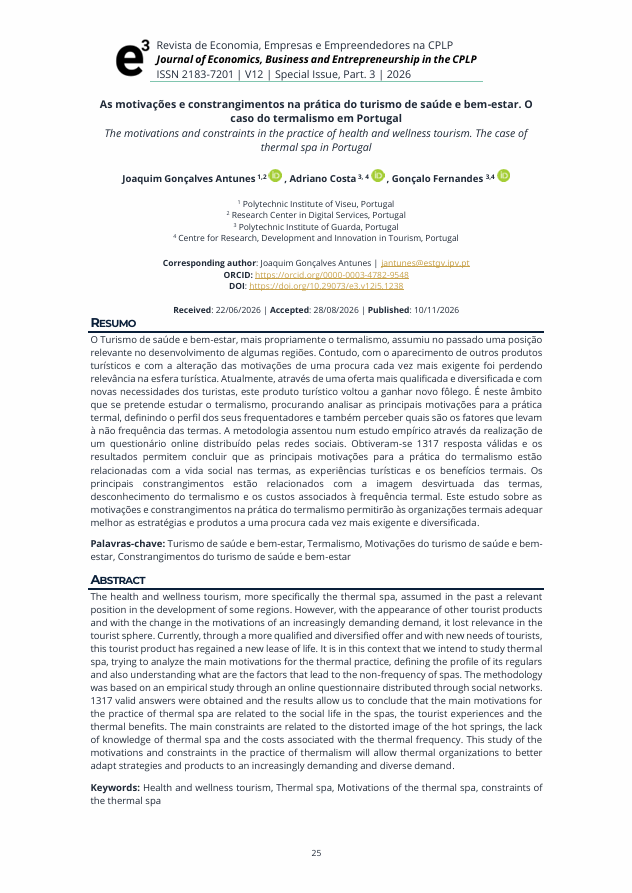
The health and wellness tourism, more specifically the thermal spa, assumed in the past a relevant position in the development of some regions. However, with the appearance of other tourist products and with the change in the motivations of an increasingly demanding demand, it lost relevance in the tourist sphere. Currently, through a more qualified and diversified offer and with new needs of tourists, this tourist product has regained a new lease of life. It is in this context that we intend to study thermal spa, trying to analyze the main motivations for the thermal practice, defining the profile of its regulars and also understanding what are the factors that lead to the non-frequency of spas. The methodology was based on an empirical study through an online questionnaire distributed through social networks. 1317 valid answers were obtained and the results allow us to conclude that the main motivations for the practice of thermal spa are related to the social life in the spas, the tourist experiences and the thermal benefits. The main constraints are related to the distorted image of the hot springs, the lack of knowledge of thermal spa and the costs associated with the thermal frequency. This study of the motivations and constraints in the practice of thermalism will allow thermal organizations to better adapt strategies and products to an increasingly demanding and diverse demand.
Downloads
Article Details

This work is licensed under a Creative Commons Attribution 4.0 International License.
All articles published in e3 – Journal of Economics, Business and Entrepreneurship in the community of Portuguese-speaking countries are licensed under the Creative Commons Attribution (CC BY) license.
This license allows users to share (copy and redistribute the material in any medium or format) and adapt (remix, transform, and build upon the material) for any purpose, including commercial use, provided that appropriate credit is given to the original author(s) and the journal, a link to the license is provided, and any changes made are indicated.



References
Antunes, J. (2012). O (re)posicionamento do termalismo como estratégia de desenvolvimento turístico. O caso da região Dão-Lafões (NUTS III). Revista Turismo & Desenvolvimento, 17-18(3), 1469-1480.
Chen, J., Prebensen, N., & Huan, T. (2008). Determining the motivation of wellness travelers. Anatolia: An International Journal of Tourism and Hospitality Research, 19(1), 103–115.
Chen, K., Chang, F., & Wu, C. (2013). Investigating the wellness tourism factors in hot spring hotel customer service. International Journal of Contemporary Hospitality Management, 25(7), 1092-1114.
Clark-Kennedy, J., & Cohen, M. (2017). Indulgence or therapy? Exploring the characteristics, motivations and experiences of hot springs bathers in Victoria, Australia. Asia Pacific Journal of Tourism Research, 22(5), 501- 511.
Costa, A. (2020). Turismo termal: Segmentação por fatores motivacionais. Dissertação de Mestrado. ISCTE-Instituto Universitário de Lisboa.
Costa, C., Quintela, J., & Mendes, J. (2015). Health and wellness tourism: A strategic plan for tourism and thermalism valorization of São Pedro do Sul. In M. Peris-Ortiz, & J. Álvarez-García (Eds.), Health and Wellness Tourism: Emergence of a New Market Segment, (pp. 21-31). Switzerland: Springer International.
DGEG (2022). https://www.dgeg.gov.pt/pt/estatistica/geologia/recursos-hidrogeologicos-e-geotermicos/termalismo/estatistica-2020/.
Esteves, A. (2017). Motivação dos turistas de saúde e bem-estar: o caso dos visitantes de termas e spas. Dissertação de Mestrado de Marketing. ISEG – Universidade de Lisboa.
Ferreira, L.; Silva, C. & Seabra, C. (2017). Motivações para a procura de SPA Tourism. Revista Turismo & Desenvolvimento, n. 27/28, 849 – 855.
Gonçalves, P.; Antunes, J. & Barroco, C. (2020). Estudo das (des)motivações para a prática de Turismo em Espaço Rural: o caso da Região Centro de Portugal. Iberian Journal of Information Systems and Technologies, N.º E36, 496-511.
GWI (Global Wellness Institute) (2018). Global Wellness Tourism Economy. November 2018.
Hashemi, S.; Jusoh, J.; Kiumarsi, S, & Mohammadi, S: (2015). Influence factors of spa and wellness tourism on revisit intention: the mediating role of international tourist motivation and tourist satisfaction. International Journal of Research, 3(7), 1-11.
INE (2020). Estatísticas do Turismo – 2019. Instituto Nacional de Estatística, I.P, ISBN 978-989-25-0542-8.
Johnston, K., Puczkó, L., Smith, M., & Ellis, S. (2011). Research Report: Global Spa Summit 2011, Wellness tourism and medical tourism: Where do spas fit? Global Spa Summit, NY.
Liberato, D., Brandão, F., Teixeira, A. & Liberato, P. (2021). Satisfaction and loyalty evaluation towards health and wellness destination. Journal of Tourism & Development, 36(2), 9–24. DOI:e-ISSN 2182-1453.
Pesonen, J. & Komppula, R. (2010). Rural Wellbeing Tourism: Motivations and Expections. Journal of Hospitality and Tourism Management, 17(1), 150–157.
Ramos, A. (2005). O Termalismo em Portugal: dos factores de obstrução à revitalização pela dimensão turística. Tese de Doutoramento. Universidade de Aveiro. Portugal.
Ramos, A., Carvalho, C. S., & Antunes, J. (2021). As expectativas dos consumidores das Caldas da Felgueira: uma análise temporal (1999-2017). Journal of Tourism & Development, 36(2), 433-445. DOI:10.34624/rtd.v36i2.8897.
Solomon, M. (2019). Consumer Behavior: Buying, Having, and Being (12th Edition), Pearson Education Limited.
Teixeira, A. (2020). O papel do Turismo de Saúde e Bem-estar nas motivações dos termalistas da região Norte e Centro de Portugal. Dissertação de Mestrado. Politécnico do Porto
Turismo de Portugal (2013). Plano Estratégico Nacional do Turismo. Revisão e objetivos 2013-2015. Governo de Portugal. Ministério da Economia e do emprego.
Walford, N. (2001). Patterns of development in tourist accommodation enterprises on farms in England and Wales. Applied Geography, 21(4), 331–345.