AS MOTIVAÇÕES E CONSTRANGIMENTOS NA PRÁTICA DO TURISMO DE SAÚDE E BEM-ESTAR. O CASO DO TERMALISMO EM PORTUGAL
Barra lateral del artículo
Contenido principal del artículo
Resumen
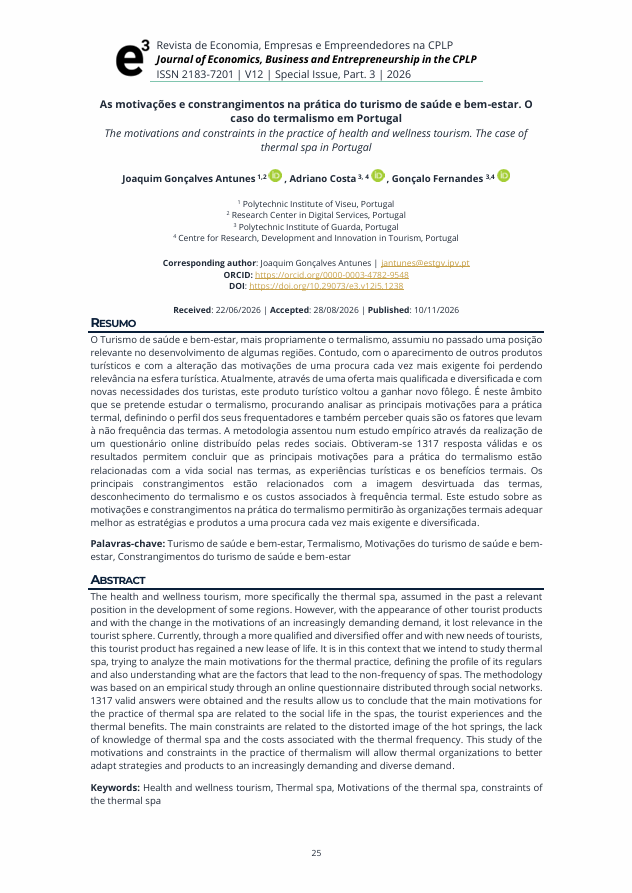
O Turismo de saúde e bem-estar, mais propriamente o termalismo, assumiu no passado uma posição relevante no desenvolvimento de algumas regiões. Contudo, com o aparecimento de outros produtos turísticos e com a alteração das motivações de uma procura cada vez mais exigente foi perdendo relevância na esfera turística. Atualmente, através de uma oferta mais qualificada e diversificada e com novas necessidades dos turistas, este produto turístico voltou a ganhar novo fôlego. É neste âmbito que se pretende estudar o termalismo, procurando analisar as principais motivações para a prática termal, definindo o perfil dos seus frequentadores e também perceber quais são os fatores que levam à não frequência das termas. A metodologia assentou num estudo empírico através da realização de um questionário online distribuído pelas redes sociais. Obtiveram-se 1317 resposta válidas e os resultados permitem concluir que as principais motivações para a prática do termalismo estão relacionadas com a vida social nas termas, as experiências turísticas e os benefícios termais. Os principais constrangimentos estão relacionados com a imagem desvirtuada das termas, desconhecimento do termalismo e os custos associados à frequência termal. Este estudo sobre as motivações e constrangimentos na prática do termalismo permitirão às organizações termais adequar melhor as estratégias e produtos a uma procura cada vez mais exigente e diversificada.
Descargas
Detalles del artículo

Esta obra está bajo una licencia internacional Creative Commons Atribución 4.0.
Todos los artículos publicados en la e3 – Revista de Economía, Empresas y Emprendimiento en la CPLP se distribuyen bajo la licencia Creative Commons Atribución (CC BY).
Esta licencia permite compartir (copiar y redistribuir el material en cualquier medio o formato) y adaptar (remezclar, transformar y crear a partir del material) para cualquier propósito, incluso comercial, siempre que se otorgue el crédito adecuado a los autores y a la revista, se proporcione un enlace a la licencia y se indiquen los cambios realizados.



Citas
Antunes, J. (2012). O (re)posicionamento do termalismo como estratégia de desenvolvimento turístico. O caso da região Dão-Lafões (NUTS III). Revista Turismo & Desenvolvimento, 17-18(3), 1469-1480.
Chen, J., Prebensen, N., & Huan, T. (2008). Determining the motivation of wellness travelers. Anatolia: An International Journal of Tourism and Hospitality Research, 19(1), 103–115.
Chen, K., Chang, F., & Wu, C. (2013). Investigating the wellness tourism factors in hot spring hotel customer service. International Journal of Contemporary Hospitality Management, 25(7), 1092-1114.
Clark-Kennedy, J., & Cohen, M. (2017). Indulgence or therapy? Exploring the characteristics, motivations and experiences of hot springs bathers in Victoria, Australia. Asia Pacific Journal of Tourism Research, 22(5), 501- 511.
Costa, A. (2020). Turismo termal: Segmentação por fatores motivacionais. Dissertação de Mestrado. ISCTE-Instituto Universitário de Lisboa.
Costa, C., Quintela, J., & Mendes, J. (2015). Health and wellness tourism: A strategic plan for tourism and thermalism valorization of São Pedro do Sul. In M. Peris-Ortiz, & J. Álvarez-García (Eds.), Health and Wellness Tourism: Emergence of a New Market Segment, (pp. 21-31). Switzerland: Springer International.
DGEG (2022). https://www.dgeg.gov.pt/pt/estatistica/geologia/recursos-hidrogeologicos-e-geotermicos/termalismo/estatistica-2020/.
Esteves, A. (2017). Motivação dos turistas de saúde e bem-estar: o caso dos visitantes de termas e spas. Dissertação de Mestrado de Marketing. ISEG – Universidade de Lisboa.
Ferreira, L.; Silva, C. & Seabra, C. (2017). Motivações para a procura de SPA Tourism. Revista Turismo & Desenvolvimento, n. 27/28, 849 – 855.
Gonçalves, P.; Antunes, J. & Barroco, C. (2020). Estudo das (des)motivações para a prática de Turismo em Espaço Rural: o caso da Região Centro de Portugal. Iberian Journal of Information Systems and Technologies, N.º E36, 496-511.
GWI (Global Wellness Institute) (2018). Global Wellness Tourism Economy. November 2018.
Hashemi, S.; Jusoh, J.; Kiumarsi, S, & Mohammadi, S: (2015). Influence factors of spa and wellness tourism on revisit intention: the mediating role of international tourist motivation and tourist satisfaction. International Journal of Research, 3(7), 1-11.
INE (2020). Estatísticas do Turismo – 2019. Instituto Nacional de Estatística, I.P, ISBN 978-989-25-0542-8.
Johnston, K., Puczkó, L., Smith, M., & Ellis, S. (2011). Research Report: Global Spa Summit 2011, Wellness tourism and medical tourism: Where do spas fit? Global Spa Summit, NY.
Liberato, D., Brandão, F., Teixeira, A. & Liberato, P. (2021). Satisfaction and loyalty evaluation towards health and wellness destination. Journal of Tourism & Development, 36(2), 9–24. DOI:e-ISSN 2182-1453.
Pesonen, J. & Komppula, R. (2010). Rural Wellbeing Tourism: Motivations and Expections. Journal of Hospitality and Tourism Management, 17(1), 150–157.
Ramos, A. (2005). O Termalismo em Portugal: dos factores de obstrução à revitalização pela dimensão turística. Tese de Doutoramento. Universidade de Aveiro. Portugal.
Ramos, A., Carvalho, C. S., & Antunes, J. (2021). As expectativas dos consumidores das Caldas da Felgueira: uma análise temporal (1999-2017). Journal of Tourism & Development, 36(2), 433-445. DOI:10.34624/rtd.v36i2.8897.
Solomon, M. (2019). Consumer Behavior: Buying, Having, and Being (12th Edition), Pearson Education Limited.
Teixeira, A. (2020). O papel do Turismo de Saúde e Bem-estar nas motivações dos termalistas da região Norte e Centro de Portugal. Dissertação de Mestrado. Politécnico do Porto
Turismo de Portugal (2013). Plano Estratégico Nacional do Turismo. Revisão e objetivos 2013-2015. Governo de Portugal. Ministério da Economia e do emprego.
Walford, N. (2001). Patterns of development in tourist accommodation enterprises on farms in England and Wales. Applied Geography, 21(4), 331–345.