FINANCIAL SUSTAINABILITY AND INVESTMENT OPPORTUNITIES IN THERMAL TOURISM VENTURES: EVIDENCE FROM SAN VICENTE, SANTA ELENA, ECUADOR
Article Sidebar
Main Article Content
Abstract
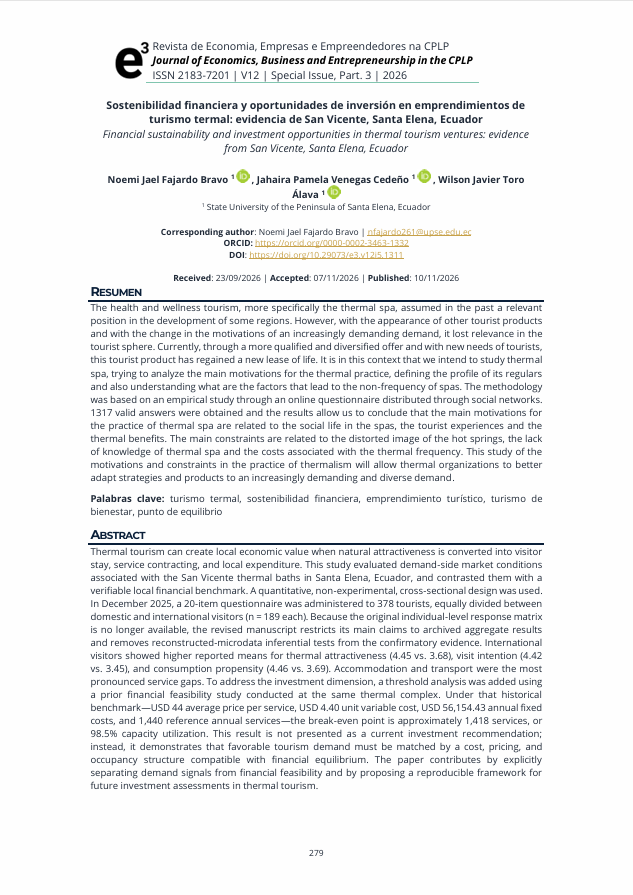
Thermal tourism can create local economic value when natural attractiveness is converted into visitor stay, service contracting, and local expenditure. This study evaluated demand-side market conditions associated with the San Vicente thermal baths in Santa Elena, Ecuador, and contrasted them with a verifiable local financial benchmark. A quantitative, non-experimental, cross-sectional design was used. In December 2025, a 20-item questionnaire was administered to 378 tourists, equally divided between domestic and international visitors (n = 189 each). Because the original individual-level response matrix is no longer available, the revised manuscript restricts its main claims to archived aggregate results and removes reconstructed-microdata inferential tests from the confirmatory evidence. International visitors showed higher reported means for thermal attractiveness (4.45 vs. 3.68), visit intention (4.42 vs. 3.45), and consumption propensity (4.46 vs. 3.69). Accommodation and transport were the most pronounced service gaps. To address the investment dimension, a threshold analysis was added using a prior financial feasibility study conducted at the same thermal complex. Under that historical benchmark—USD 44 average price per service, USD 4.40 unit variable cost, USD 56,154.43 annual fixed costs, and 1,440 reference annual services—the break-even point is approximately 1,418 services, or 98.5% capacity utilization. This result is not presented as a current investment recommendation; instead, it demonstrates that favorable tourism demand must be matched by a cost, pricing, and occupancy structure compatible with financial equilibrium. The paper contributes by explicitly separating demand signals from financial feasibility and by proposing a reproducible framework for future investment assessments in thermal tourism.
Downloads
Article Details

This work is licensed under a Creative Commons Attribution 4.0 International License.
All articles published in e3 – Journal of Economics, Business and Entrepreneurship in the community of Portuguese-speaking countries are licensed under the Creative Commons Attribution (CC BY) license.
This license allows users to share (copy and redistribute the material in any medium or format) and adapt (remix, transform, and build upon the material) for any purpose, including commercial use, provided that appropriate credit is given to the original author(s) and the journal, a link to the license is provided, and any changes made are indicated.



References
Bhuyan, K. N., Naik, R., & Khangarot, G. (2025). Wellness tourism: Nurturing nature and achieving sustainable development goals (SDGs) while travelling. Environment, Development and Sustainability. https://doi.org/10.1007/s10668-025-06183-7
Choe, J., Tam, B. T., Ha, D. T. K., & Nga, B. T. (2026). Local stakeholders’ perspectives on food-related wellness tourism in Central Vietnam: Challenges and opportunities. Tourism Recreation Research, 51(3), 955–967. https://doi.org/10.1080/02508281.2025.2506177
Gobierno Autónomo Descentralizado Provincial de Santa Elena. (2019, 11 de noviembre). Turismo se fortalece con nueva vía en Baños Termales de San Vicente. https://santaelena.gob.ec/index.php/noticias-menu/boletines/1163-turismo-se-fortalece-con-nueva-via-en-banos-termales-de-san-vicente
Gundogdu, I., & Oktay, K. (2026). Health tourism potential of Kyrgyzstan and a model proposal for sustainable health tourism development. Asia Pacific Journal of Tourism Research. https://doi.org/10.1080/10941665.2026.2662279
Jaiyesimi, B. G., Okokpujie, I. P., David, D. D., Owolabi, H., Ikumapayi, O. M., & Afolalu, S. A. (2025). Developing wellness tourism infrastructure in Africa: Strategies for growth and innovation. NIPES - Journal of Science and Technology Research, 7(2 Special Issue), 3822–3827. https://doi.org/10.37933/nipes/7.4.2025.SI473
Karreman, N., Zenone, M., Maani, N., & Hawkins, B. (2026). The political economy of wellness: Commercial determinants of a burgeoning industry. Milbank Quarterly, 104(2), 361–385. https://doi.org/10.1111/1468-0009.70088
Khan, A., Bibi, S., Hussain, S., & Lyu, J. (2025). Rural tourism impact on rural depopulation: Evidence from China. Tourism Review. https://doi.org/10.1108/TR-02-2025-0121
Laínez Suárez, A. F. (2018). Turismo comunitario como aporte al buen vivir de la comunidad de Baños de San Vicente, cantón Santa Elena, provincia de Santa Elena, año 2016 [Trabajo de titulación, Universidad Estatal Península de Santa Elena]. Repositorio UPSE. https://repositorio.upse.edu.ec/items/1f810b04-7447-4593-bd38-bf53d29bf2d8
Lawasi, M. A., Kenda, N., Yusnikusumah, T. R., Pratama, B. B., Pratiwi, D., Septina, A. D., & Asrawijaya, E. (2025). Forest-based ecotourism in Indonesia: A comprehensive review of policy challenges, diverse practices, stakeholder engagement, conservation efforts, and socioeconomic aspects. Geojournal of Tourism and Geosites, 60, 1041–1056. https://doi.org/10.30892/gtg.602spl02-1478
Nazir, F., & Kumar, J. (2025). Wellness and health tourism in Malaysia: Current barriers and recommendations. In Perspectives on Asian Tourism (pp. 141–154). Springer. https://doi.org/10.1007/978-981-96-2867-4_9
Palacios Paredes, E. W., Busto Yera, Y., & Espinosa, K. (2015). Potencialidades de las aguas termales como turismo alternativo en el Ecuador. Revista Científica UISRAEL, 2(2), 57–66.
Rodríguez Reyes, E. E. (2014). Estudio de factibilidad para la creación de cabañas en el complejo turístico Telésforo Villacrés de Baños de San Vicente, cantón Santa Elena, provincia de Santa Elena, año 2014 [Trabajo de titulación, Universidad Estatal Península de Santa Elena]. Repositorio UPSE. https://repositorio.upse.edu.ec/items/d0499695-243c-457a-83d5-691bf9d72060
Safarov, B., Mansurova, N., Hasanov, H., Xayrullayev, A., Sanayeva, R., & Yu, J. (2026). Analysis of factors influencing the development of health and wellness tourism in the context of sustainable urban and regional development in Uzbekistan. Lecture Notes in Computer Science, 15890, 405–414. https://doi.org/10.1007/978-3-031-97606-3_27
Sharma, R., Mani, A. P., Taneja, S., Johri, A., Uddin, M., & Qureshi, S. K. (2026). Business leadership in tourism startups: A PLS-SEM analysis of interrelationships between sustainable business practices, competitive advantage, and financial performance. Business Ethics and Leadership, 10(2), 375–392. https://doi.org/10.61093/bel.10(2).375-392.2026
Smith, M. K. (2025). Health tourism in Hungary: Future challenges for thermal spas. Worldwide Hospitality and Tourism Themes, 17(2), 187–199. https://doi.org/10.1108/WHATT-01-2025-0027
Velikova, E. (2026). Thermal waters and sustainable wellness tourism: A nexus for responsible resource use in Bulgaria. In Environmental Science and Engineering (pp. 149–158). Springer. https://doi.org/10.1007/978-3-032-08652-5_13
Vereskova, M., Zachová Tichá, A., Maráček, M., & Huseynli, A. (2025). The implementation potential of innovative technologies in Czech spa care. Rehabilitacia, 62(4), S1–S15. https://doi.org/10.61983/lcrh.v62i4.134