COSTING AND MANAGEMENT CONTROL PRACTICES IN THE HOTEL SECTOR: CASE STUDY
Article Sidebar
Main Article Content
Abstract
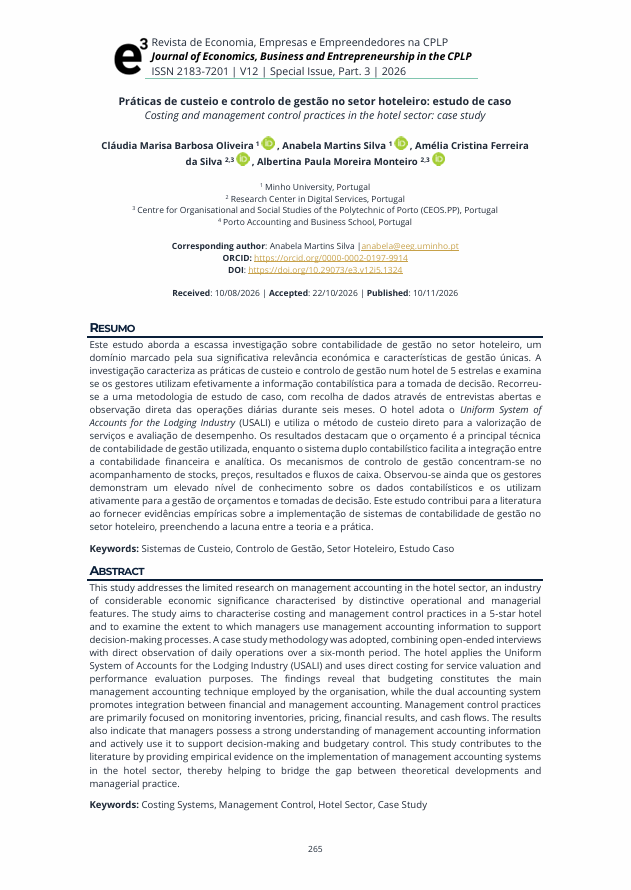
This study addresses the limited research on management accounting in the hotel sector, an industry of considerable economic significance characterised by distinctive operational and managerial features. The study aims to characterise costing and management control practices in a 5-star hotel and to examine the extent to which managers use management accounting information to support decision-making processes. A case study methodology was adopted, combining open-ended interviews with direct observation of daily operations over a six-month period. The hotel applies the Uniform System of Accounts for the Lodging Industry (USALI) and uses direct costing for service valuation and performance evaluation purposes. The findings reveal that budgeting constitutes the main management accounting technique employed by the organisation, while the dual accounting system promotes integration between financial and management accounting. Management control practices are primarily focused on monitoring inventories, pricing, financial results, and cash flows. The results also indicate that managers possess a strong understanding of management accounting information and actively use it to support decision-making and budgetary control. This study contributes to the literature by providing empirical evidence on the implementation of management accounting systems in the hotel sector, thereby helping to bridge the gap between theoretical developments and managerial practice.
Downloads
Article Details

This work is licensed under a Creative Commons Attribution 4.0 International License.
All articles published in e3 – Journal of Economics, Business and Entrepreneurship in the community of Portuguese-speaking countries are licensed under the Creative Commons Attribution (CC BY) license.
This license allows users to share (copy and redistribute the material in any medium or format) and adapt (remix, transform, and build upon the material) for any purpose, including commercial use, provided that appropriate credit is given to the original author(s) and the journal, a link to the license is provided, and any changes made are indicated.



References
Abdel-Maksoud, A., Kamel, H., & Elbanna, S. (2016). Investigating relationships between stakeholders' pressure, eco-control systems and hotel performance. International Journal of Hospitality Management, 59, 95–104. https://doi.org/10.1016/j.ijhm.2016.09.006
Arbelo, A., Arbelo-Pérez, M., & Pérez-Gómez, P. (2017). Impact of cost efficiency on performance in the hotel industry. Tourism Economics, 23(2), 330–338. https://doi.org/10.1177/1096348015587999
Ardiansyah, G. B., Tjahjadi, B., & Soewarno, N. (2017). Measuring customer profitability through time-driven activity-based costing: A case study at Hotel X Jogjakarta. SHS Web of Conferences, 34, Article 08004. https://doi.org/10.1051/shsconf/20173408004
Bénet, N., Deville, A., Raïes, K., & Valette-Florence, P. (2022). Turning non-financial performance measurements into financial performance: The usefulness of front-office staff incentive systems in hotels. Journal of Business Research, 142, 317–327. https://doi.org/10.1016/j.jbusres.2021.12.017
Bonzanini, O. A., Silva, A., Cokins, G., & Gonçalves, M. J. (2020). The interaction between higher education institutions and professional bodies in the context of digital transformation: The case of Brazilian accountants. Education Sciences, 10(11), Article 321. https://doi.org/10.3390/educsci10110321
Chan, E. S. W., & Hsu, C. H. C. (2016). Environmental management research in hospitality. International Journal of Contemporary Hospitality Management, 28(5), 886–923. https://doi.org/10.1108/IJCHM-02-2015-0076
Collier, P., & Gregory, A. (1995). Strategic management accounting: A UK hotel sector case study. International Journal of Contemporary Hospitality Management, 7(1), 16–21.
Cruz, I. (2007). How might hospitality organizations optimize their performance measurement systems? International Journal of Contemporary Hospitality Management, 19(7), 574–588.
Cruz, I., Scapens, R. W., & Major, M. (2011). The localisation of a global management control system. Accounting, Organizations and Society, 36(7), 412–427. https://doi.org/10.1016/j.aos.2011.08.001
Cuckovic, E. R., & Jankovic, S. (2018). Quality costing in the hospitality industry: A literature review. Tourism & Hospitality Industry 2018: Trends and Challenges, 368–382.
Cunha, L. (2006). Economia e política do turismo. Editorial Verbo.
Cunha, L. (2010). Desenvolvimento do turismo em Portugal: Os primórdios. Fluxos & Riscos, 1, 127–149.
Dalci, I., Tanis, V., & Kosan, L. (2010). Customer profitability analysis with time-driven activity-based costing: A case study in a hotel. International Journal of Contemporary Hospitality Management, 22(4–5), 609–637. https://doi.org/10.1108/09596111011053774
Dutra, A. R. C. S., & Callado, A. A. C. (2022). Empirical study at João Pessoa hotels (Brazil). Anuario Turismo y Sociedad, 30, 93–106. https://doi.org/10.18601/01207555.n30.05
Esparza-Aguilar, J. L., García-Pérez-de-Lema, D., & Duréndez, A. (2016). The effect of accounting information systems on the performance of Mexican micro, small and medium-sized family firms: An exploratory study for the hospitality sector. Tourism Economics, 22(5), 1104–1120. https://doi.org/10.5367/te.2015.0515
Faria, A. R. (2007). A contabilidade aplicada ao setor hoteleiro: Uma perspetiva histórica. IV Jornada de História da Contabilidade.
Faria, A. R., Trigueiros, D., & Ferreira, L. (2012). Práticas de custeio e controlo de gestão no setor hoteleiro do Algarve. Tourism & Management Studies, 8(1).
Ferreira-da-Silva, A., Pereira, J. M., Lopes, A., Magalhães, C., & Moreira, R. (2015). Foucault’s perspective of performance appraisal in public administration. Mediterranean Journal of Social Sciences, 6(2), 375.
Franco, V. S., Oliveira, Á. V. de, Morais, A. I., Oliveira, B. de J., Lourenço, I. C., Major, M. J., Jesus, M. A., & Serrasqueiro, R. (2009). Temas de contabilidade de gestão: Os custos, os resultados e a informação para a gestão. Livros Horizonte.
Lamelas, J. (2011). Direção hoteleira em equipa com o USALI e o BSC: Para uma gestão mais eficaz e eficiente. Journal of Tourism Studies, 55–79.
Lima Santos, L., Gomes, C., & Arroteia, N. (2010). Determinantes da contabilidade de gestão nas unidades hoteleiras de Portugal. XIV Encontro AECA. Universidade de Coimbra.
Lizote, S. A., de Fátima Teston, S., Vitali, G., & de Morais Noval, C. (2020). Custos e formação do preço de vendas em hotéis. Navus – Revista de Gestão e Tecnologia, 10, 1–11. https://doi.org/10.22279/navus.2020.v10.p01-11.1126
Makrigiannakis, G., & Soteriades, M. (2007). Management accounting in the hotel business: The case of the Greek hotel industry. International Journal of Hospitality & Tourism Administration, 8(4), 47–76.
Martins, F. A., Ferreira-da-Silva, A., & Machado-Santos, C. (2015). Gestão dos stakeholders na captação de recursos nos hospitais filantrópicos e religiosos. Revista de Administração Contemporânea, 18, 65–85.
Mesquita, C., Santos, J. F., da Silva, A. F., & Silva, A. M. (2020). Novos modelos de planeamento e controlo de gestão nos hospitais públicos portugueses. Revista de Gestão em Sistemas de Saúde, 7(3), 239–256.
Mia, L., & Patiar, A. (2001). The use of management accounting systems in hotels: An exploratory study. International Journal of Hospitality Management, 20(2), 111–128. https://doi.org/10.1016/S0278-4319(00)00033-5
Mohamed, R., & Jamil, C. Z. M. (2015). Management control systems in small medium hotels and their effect on performance. Advanced Science Letters, 21(6), 1882–1885. https://doi.org/10.1166/asl.2015.6145
Nunes, C. R. (2009). O controlo de gestão na hotelaria portuguesa. ISCTE.
Ordem dos Técnicos Oficiais de Contas. (2010). Regulamento de inscrição, estágio e exame profissionais.
Pavlatos, O., & Paggios, I. (2007). Cost accounting in Greek hotel enterprises: An empirical approach. Tourismos, 2(2), 39–59.
Pavlatos, O., & Paggios, I. (2009a). Management accounting practices in the Greek hospitality industry. Managerial Auditing Journal, 24(1), 81–98.
Pavlatos, O., & Paggios, I. (2009b). A survey of factors influencing the cost system design in hotels. International Journal of Hospitality Management, 28(2), 263–271. https://doi.org/10.1016/j.ijhm.2008.09.002
Pavlatos, O., & Paggios, I. (2009c). Activity-based costing in the hospitality industry: Evidence from Greece. Journal of Hospitality & Tourism Research, 33(4), 511–527. https://doi.org/10.1177/1096348009344221
Pereira, J., Basto, M., & Silva, A. (2017). Comparing logit model with discriminant analysis for predicting bankruptcy in Portuguese hospitality sector. European Journal of Tourism Research, 16, 276–280.
Pimentel, P., & Abrantes, J. L. (2022). O papel da hotelaria na redução dos efeitos da sazonalidade na Região de Coimbra. Journal of Tourism & Development, 39, 101–114.
Santos, C., Rocha, Á., & Silva, A. (2025). Management accounting as a business intelligence system: Examination in Portuguese small and medium enterprises. Neural Computing and Applications, 37(31), 25789–25803.
Yin, R. K. (2018). Case study research and applications: Design and methods (6th ed.). SAGE Publications.