
TURISMO, CRIAÇÃO DE VALOR E MUDANÇA TERRITORIAL: DESAFIOS CONTEMPORÂNEOS PARA GESTÃO, INOVAÇÃO E SUSTENTABILIDADE
Article Sidebar
Main Article Content
Resumo
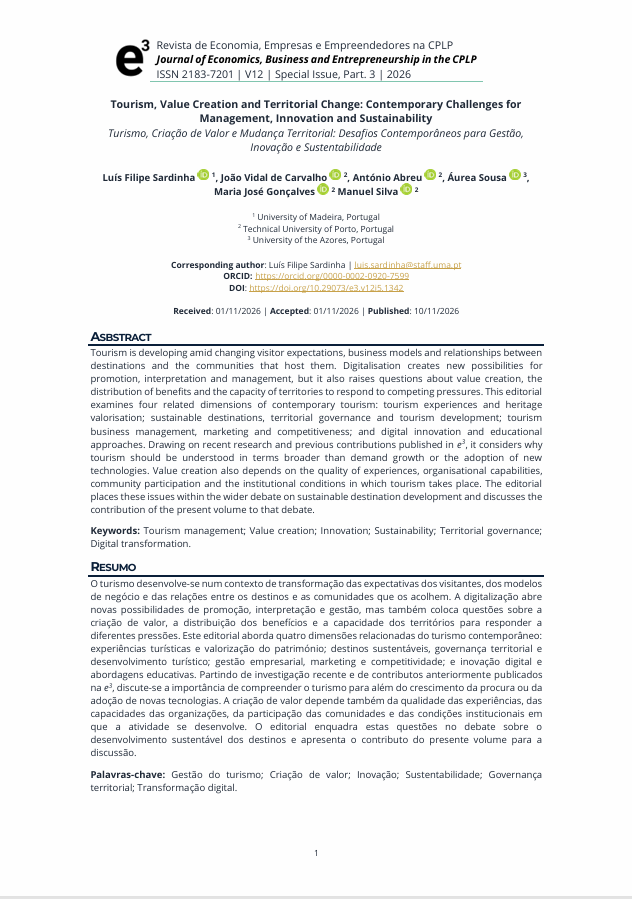
O turismo desenvolve-se num contexto de transformação das expectativas dos visitantes, dos modelos de negócio e das relações entre os destinos e as comunidades que os acolhem. A digitalização abre novas possibilidades de promoção, interpretação e gestão, mas também coloca questões sobre a criação de valor, a distribuição dos benefícios e a capacidade dos territórios para responder a diferentes pressões. Este editorial aborda quatro dimensões relacionadas do turismo contemporâneo: experiências turísticas e valorização do património; destinos sustentáveis, governança territorial e desenvolvimento turístico; gestão empresarial, marketing e competitividade; e inovação digital e abordagens educativas. Partindo de investigação recente e de contributos anteriormente publicados na e3, discute-se a importância de compreender o turismo para além do crescimento da procura ou da adoção de novas tecnologias. A criação de valor depende também da qualidade das experiências, das capacidades das organizações, da participação das comunidades e das condições institucionais em que a atividade se desenvolve. O editorial enquadra estas questões no debate sobre o desenvolvimento sustentável dos destinos e apresenta o contributo do presente volume para a discussão.
Downloads
Article Details

Este trabalho encontra-se publicado com a Licença Internacional Creative Commons Atribuição 4.0.
Todos os artigos publicados na e3 – Revista de Economia, Empresas e Empreendedorismo na CPLP são disponibilizados sob a licença Creative Commons Atribuição (CC BY).
Esta licença permite partilhar (copiar e redistribuir o material em qualquer suporte ou formato) e adaptar (remisturar, transformar e criar a partir do material) para qualquer finalidade, incluindo fins comerciais, desde que seja atribuída a devida autoria aos autores e à revista, seja fornecida ligação para a licença e sejam indicadas eventuais alterações.



Referências
Abreu, A., Carvalho, J. V., Sardinha, L. F., Sousa, Á., Gonçalves, M. J., & Silva, M. (2026). Tourism, innovation and territorial development: contemporary dynamics and sustainability challenges. In E3 Journal of Economics, Business and Entrepreneurship in the Community of Portuguese-Speaking Countries (Vol. 12, Number 3, pp. 01–05). Ponteditora. https://doi.org/10.29073/e3.v12i3.1103
Ates, H. (2026). Human-centered GenAI feedback design in higher education: a multisite experiment on direct, reflective, and hybrid approaches to scientific argumentation. International Journal of Educational Technology in Higher Education, 23(1), 38. https://doi.org/10.1186/s41239-026-00614-9
Ballina, F. J. (2026). Integration over intensity: field-experimental evidence on phygital design in heritage tourism. Information Technology & Tourism, 28(2), 61. https://doi.org/10.1007/s40558-026-00403-0
Barreth, A., Alvarado, E., & Chalen, D. (2025). CULTURAL TOURISM PRODUCT FOR THE CANTON GENERAL VILLAMIL PLAYAS, ECUADOR. E3, 11(2), 07–20. https://doi.org/10.29073/e3.v12i3.1081
Carvalho, H., Pocinho, R., Casillas-Martín, S., & García-Peñalvo, F. (2026). PREPARATION AND PERCEIVED APTITUDE IN HIGHER EDUCATION IN PORTUGAL. E3, 12(1), 141–155. https://doi.org/10.29073/e3.v9i1.1055
Chang, T.-Y., Tsai, H.-Y., Wu, T.-H., & Su, C.-M. (2026). Developing a decision framework for selecting key opinion leaders in hospitality marketing: A Fuzzy Delphi and AHP approach. International Journal of Hospitality Management, 135, 104608. https://doi.org/10.1016/j.ijhm.2026.104608
Chen, L., Li, X., Zhang, J., Zhang, M., & Liu, S. (2026). Humorous or serious? The impact of heritage interpretation styles on tourists’ memorable tourism experiences. Journal of Hospitality and Tourism Management, 68, 101545. https://doi.org/10.1016/j.jhtm.2026.101545
Coelho, J., & Lima, D. (2025). ACADEMIC INTELLIGENCE: DATA, TECHNOLOGY, AND EDUCATIONAL TOURISM IN SYNERGY. E3, 11(2), 65–74. https://doi.org/10.29073/e3.v11i2.1045
Esteves, E., Ribeiro, M., & Morais, E. (2025). DIGITAL MARKETING IN THE TOURIST RESORTS OF TERRAS DE TRÁS-OS-MONTES. E3, 11(2), 47–56. https://doi.org/10.29073/e3.v12i3.1092
Kar, T., Öztürk, F., Özkaya, M., & Öçal, M. F. (2026). Exploring Teachers’ Practices and Intentions in Formulating Geometry Problems to Support Student Learning. International Journal of Science and Mathematics Education, 24(3), 29. https://doi.org/10.1007/s10763-026-10646-2
Lee, H., Li, P., Chen, P., Huang, Y., & Wu, T. (2026). Enhancing Flipped Learning With Convergent Feedback: The Impact of GPTutor on Knowledge Construction, Motivation and Engagement in Higher Education. European Journal of Education, 61(1). https://doi.org/10.1111/ejed.70527
Liu, Y., Chia, K. W., Katahenggam, N., Sthapit, E., Garrod, B., & Zerman, S. (2026). Dual mediating role of perceived authenticity and place satisfaction on intention to revisit a technology-enhanced cultural heritage tourism site. Journal of Vacation Marketing. https://doi.org/10.1177/13567667261473693
Mandić, A., & Pivčević, S. (2026). Living Labs as Governance Mechanisms for Sustainable Tourism Monitoring: Evidence From Six European Destinations. International Journal of Tourism Research, 28(3). https://doi.org/10.1002/jtr.70346
Napierała, T., & Tomczyk, A. T. (2026). New face of platform capitalism in lodging industry: Who and where adopts platform-led loyalty tools? Tourism Economics, 32(4), 879–903. https://doi.org/10.1177/13548166261421402
Peco-Torres, F., Jones, A., Polo-Peña, A. I., & Frías-Jamilena, D. M. (2026). Customer brand engagement via value co-creation with hotel online media and travel websites and its effect on brand equity: the moderating role of culture. Journal of Hospitality and Tourism Technology, 17(1), 192–211. https://doi.org/10.1108/JHTT-06-2024-0362
Pedrosa, A., Martins, F., Breda, Z., Lois González, R., & Costa, A. P. (2026). Critical success factors for tourism routes: insights from route characteristics. Journal of Tourism and Cultural Change, 24(2), 282–303. https://doi.org/10.1080/14766825.2026.2669169
Rodríguez, M., Mora-Jácome, V., & Vallejo, L. (2025). IMPACT OF SOCIODEMOGRAPHIC VARIABLES ON THE CHOICE OF URBAN TOURIST ATTRACTIONS APPLYING PLOG’S THEORY. E3, 11(2), 137–146. https://doi.org/10.29073/e3.v12i3.1067
Rosalina, P. D., & Teoh, M. W. (2026). Crafting wellness tourism products for sustainable development: Local stakeholders’ perspectives. Journal of Hospitality and Tourism Management, 67, 101426. https://doi.org/10.1016/j.jhtm.2026.101426
Seixas Sardinha, L. F., Fernandes, D. N., & Moura, J. (2019). Alojamento Local na Região Autónoma da Madeira - Tipologia e distribuição do Imóvel. O Perfil do Investidor. Revista de Economia Empresas e Empreendedores Na CPLP, 4(No2), 25–56. https://doi.org/10.29073/e3.v4i2.129
Sofi, M. R., Bashir, I., Alshiha, A. A., Alnasser, E. M., Alkhozaim, S. M., Charag, A. H., & Alshiha, F. A. (2026). From Digital Strategies to Loyal Stays: Exploring the Impact of DMC , CRM , and Trust on Hotel Revisit Intentions. International Journal of Tourism Research, 28(2). https://doi.org/10.1002/jtr.70235
Suasnavas Rodríguez, M. (2026). TOURISM DEVELOPMENT AND PLANNING ZAMORA- ECUADOR. E3, 12(4), 29–41. https://doi.org/10.29073/e3.v12i4.1144
Valencia-Arias, A., Cardona-Acevedo, S., Palacios Moya, L., Londoño-Celis, W., Hernandez, J., & Vanegas, E. (2026). PLANNING IN TOURISM DEVELOPMENT: A SYSTEMATIC REVIEW OF THE LITERATURE ON APPROACHES, MODELS AND APPLICATIONS. E3, 12(4), 11–27. https://doi.org/10.29073/e3.v12i4.1148
Vidal Carvalho, J., Abreu, A., Sardinha, L. F., Sousa, Á., Gonçalves, M. J., & Silva, M. (2026). RECONFIGURING TOURISM SYSTEMS: DIGITAL INTELLIGENCE, TERRITORIAL GOVERNANCE AND ORGANIZATIONAL TRANSFORMATION. E3, 12(4), 01–09. https://doi.org/10.29073/e3.v12i4.1202
Wang, K., Qin, S., Shen, Y., Guo, J., Ruan, Q., & Jia, T. (2026). Effects of AI chatbot‐supported cooperative flipped classroom on student collaboration, self‐regulated learning and academic performance: A mastery learning perspective. British Journal of Educational Technology. https://doi.org/10.1111/bjet.70079
Zhang, L., & McCartney, G. (2026). The Mediating Role of Positive Empathy in Resident Participation in Sustainable Tourism: Evidence From an Ancient Chinese Town. International Journal of Tourism Research, 28(2). https://doi.org/10.1002/jtr.70301